PORTSCATHO · 1950s & 60s
A Walk Through Portscatho's Past
Memories of village life, by John Peters

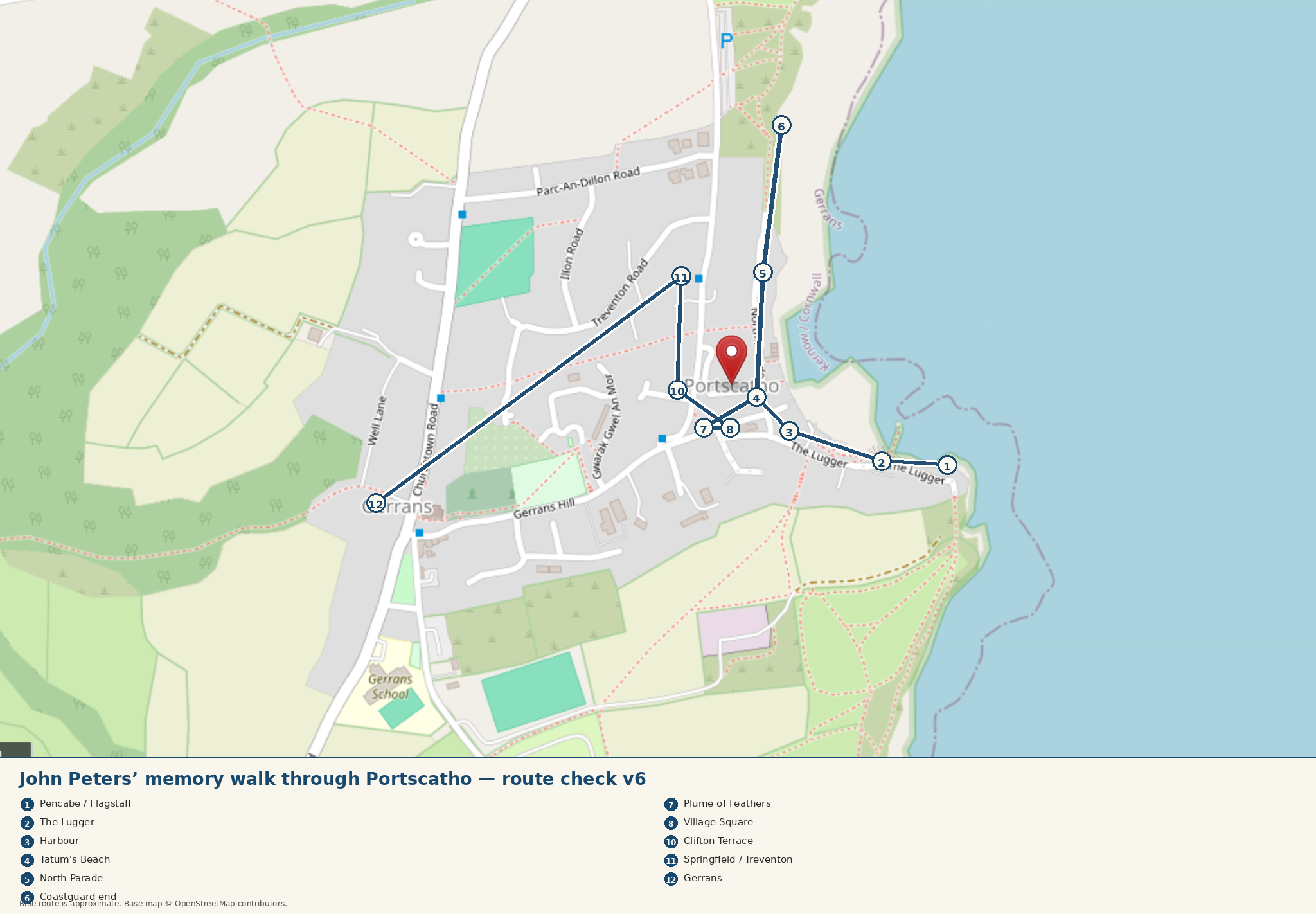
John Peters' memory walk through Portscatho, reconstructed from his original hand-marked route.
A village remembered
In the years 1946 to 1950’s there was a ‘baby boom' in Portscatho, this profusion of youngsters benefited from growing up together, going to Gerrans CP school, learning from each other on the streets and in the harbour. Living in such an idyllic place to grow up we had it Good!
I’m taking a walk through the village in the fifties/sixties, where everyone knew everyone else, doors weren’t locked, they all looked out for each other. The following is a snap shot of personal memories which come to mind as I mentally walk through the village.
After the war the area was generally poor and emerging from rationing.The military veterans were coming home and trying to find work and get settled.
The small village was ripe for expansion and the Council built the Springfield and Treventon Road houses changing the character of Portscatho the little fishing hamlet forever.
I was part of that gang growing up around the mid nineteen fifties. I thought I would do a walk of memories and the notable friends relevant to me in the village.
Starting at Pencabe the things I remember as I walk along I have tried to recall as follows, you might remember them and are perhaps even related. Apologies for mistakes and those I have forgotten, this is really relevant to my peer group, as others will find the narrative possibly just a list of names.
The walk begins — Pencabe
Starting at the bench lookout seat at Flagstaff, Pencabe, the flagpole long gone,just the bae bracket in the hedge next to the seat.The vantage place where the ‘Huer’ (the spotter for pilchard shoals), in my grandfather's day, would stand and call to the fishermen to put to sea.
Walking down the stone steps from the cliff path to the southeasterly end of the village onto the cobbled road, on the right-hand side cottage was lived in by Goeff Counsell who later married Brenda Yelland from Bohortha farm, sister to Pat, and daughters of Ken and Eileen. Geoff managed the farm with Ken and ran their haulage business.
Strolling into the village past the Conformist Church, headstones all round the walls with names of my Peters family ancestors. The house where Jeanie Mac lived,a real character. Past the small hut on the seaward side or the road which never seemed to be used and was so small it had no obvious use.
Now pasting next to the stone wall which retained the car park /yard of William (Bill) ‘Pudgy’ Sawles Garage, It was a big corrugated galvanised shed set back into the cliff. The rusty corrugated tin roof had seen better days and was full of holes and the whole place seemed to be covered in oil. A couple of old hand cranked petrol pumps and a few dilapidated cars. Now the site is a block of modern apartments.
On the seaward side of the garage is a grassy area over the top of the harbour with a couple of wood bench seats and a red painted sea war sea mine with a charity coin slot in the top for shipwrecked seamen In those days it was still fitted with brass prongs all round which were the detonators.
Below the mine is a curving track leading down under the cliff to a harbourside shelter, it had no sides, but a solid concrete roof and a green painted bench seat; it was very useful when it rained.
The Lugger
Now progressing along the Lugger with its white washed walls capped with black apex stones. ( I never have sourced why it is called the Lugger, as this is actually the name of a type of sailing ship ).The houses along the Lugger were not yet second homes but were occupied mostly by elderly folk, a Miss Dinney comes to mind, so no youngsters lived here except in the mid sixties when a couple of young girls from Sheffield called Kaye and Angie came to work in the hotels, they moved in to Mr.Peto’s top flat they provided a great base for parties.
The Lugger wall became the meeting place for everyone, leaning over the wall with its spectacular view of the harbour (Porth) and the whole of Gerrans Bay with Nare Head and Gull Rock in the distance. Although we saw this vista every day its beauty and splendour never failed to captivate.
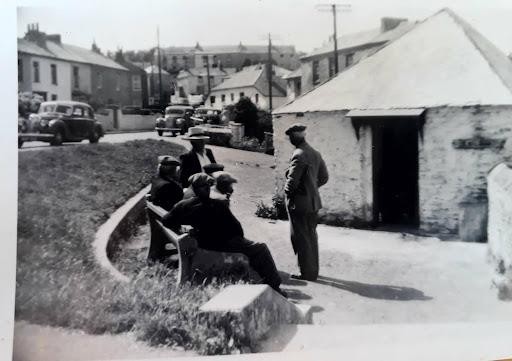
The Fisherman's Shelter
At the end of the wall is the Fisherman's Shelter, like a small whitewashed square building with peaked tiled roof and chimney pot. A tall wooden flag pole with brass wind vane on top outside. This was the domain of the old guard, Jackie Wilmott, Harold Nicholls,Vic Peters,Sam Lobb,John Eddy Nicholls, Charlie Pope and Morley Billing the Harbourmaster. No youngsters were allowed near the Shelter, threatened with a ‘thick ear’. B…’ off you B…’. Nuisances! The ex fishermen would lean over the wall and intently watch us hooligans playing in the Porth, swimming and boating.
The Harbour and Post Office
Now we are at the top of the slipway and access down to the harbour and on the left was the Post Office, run by Jerry Gill. The Post Office also had a window which in the summer was opened to serve ice creams.
Outside the Post Office at the top of the Slip was an old rusty iron wire winch.This was used to wind the boats up the steep slip. The slip had cast iron rollers set in pockets about every six feet apart for the boat's keels to run on.( now all filled in). If a strong Easterly wind was forecast, or blew up, everyone turned up and the boats were hauled up out of the harbour, The winch wire was pulled down via a turning ‘snatch’ block on the beach to the boat. The winch had crankhandles each side which the strongest men, sometimes two per side, wound making a lovely clicking sound of the brake pauls. If the boat was on the sand wood rollers were put under the keel until it got to the slipway rollers. All very exciting and hard work, our jobs were to hold the boat upright and feed the wood rollers under, then collect them as they popped out the stern, carry them back to the bow and pop them in again. The rule was not to go anywhere near the straining wire.
Sadly the winch was removed and replaced with a motor driven one, housed in an ugly concrete box shed built at the top of the slip next to the quaint Fishermen's Shelter.
My First Boats
When I was about eleven my father bought me my first boat,a 10ft clinker rowing boat ’Dab-Dab’ I spent hours in that boat, Father knew very little about sailing but he did fit a couple of swivelling lee boards to the sides and a lug sail to the front seat and I taught myself to sail. I would row to Portcunick Beach and if the wind was right sail back to the harbour. Wisdom given by the fishermen was ‘ You go away against the wind boy, it will then blow you home’.
I soon found I could hire out the boat to visitors and make pocket money. The money was saved and I bought a lovely 12ft carvel rowing boat ‘Buccaneer’ and then Seagull 40 plus outboards to go on the back of the boats, so I could expand my boat letting business. If I got really busy, I borrowed other boats to let out.
The proceeds from the boats enabled me to buy a 10ft. clinker all varnish proper sailing boat with a centreboard keel. After that I sold the sail boat and with a lot of help from my father bought a Bell Woodworking kit and we built an Enterprise racing dinghy. Father being a naval Shipwright and time served boatbuilder gave me a huge input into repairing my boats and boatbuilding.
HISTORICAL CONTEXT
Boats and owners in Portscatho circa 1962
You might find the list of boats and surnames brings back memories……..Copied from a pocket book in which I logged my summer boat rentals to the visitors.The average was six shillings (30p) per hour for a 14ft. boat with (slightly unreliable) Seagull 40+ outboard motor. The largest expense was a new outboard motor ordered through Bill Curtis at Highertown Garage which cost £27-17s-6p on 19/06/1962.
The annual regatta
As youngsters we were so lucky to have the Porth and whole area as a playground.
The absolute highlight of the summer was the annual regatta. The whole village could not help but get involved. It would start with the hanging of the flags along the Lugger and setting up trestle tables from the Memorial Hall. My highlight was always sailing, competing in my Enterprise, Bombers Merlin Rocket and later Sunbeam and lately Falmouth Working Boat, Rita. In later years Bomber took over as Regatta Chairman and with a microphone outside the Fisherman's Shelter and did a humorous running commentary on the sailing racing and the presented the cups and prizes.
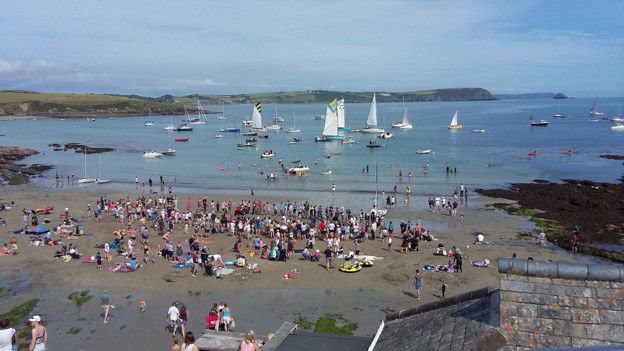
The day was non stop ending with the carnival and the band playing the Flora Dance and marching in one side of the Plume and out the other, a tradition which still goes on. The Working boats were always the visual highlight and the crews came ashore for a free barrel of beer and pasties in the Social Club. Legends like Toby West, Aubrey Chandler,Smokey Penrose, and a host of Falmouth Harbour legends would end up in the Club singing their hearts out. By closing time they had to weave their way back to the Porth and somehow get a lift out to the boats moored in the Pit and sail home. I remember one year Ray Wilkes from Falmouth was negotiating the stone path from the centre of the Lugger down to the breakwater, and as there are no railings, he stepped over the edge and fell to the lower pathway. He was very lucky, I think if he wasn’t so inebriated he would have been seriously hurt, or worse. However he picked himself up and sailed home to sail another day!
Towards River Street
Behind the Post Office lived the Greet family, one of the old names of the village, Hilary Thompson (nee Greet) became a fantastic historian of local life and the village. Her books are a fascinating read, full of the history of the village, its life and families.
On the opposite side of the Lugger in front of the Slipway is a big detached house ‘Trehaven’ built by Captain Thomas Peters who unfortunately was drowned. In my day it was owned by the Warwick James family as a second home, their son Jolyon visited and stayed in the summers. Also used for a retreat by the Andain family who had a daughter Jane.
Along the Lugger road on the left lived Rodney Nicholls who part owned the Building Company ‘Nicholls and Nicholls’ based in the Quarry with his cousin Bruce Nicholls. The company was started by their fathers .Rodney had a daughter Caroline who tragically passed away young.
Our stroll now bears right down towards River Street on the right lived John Roberts, his father had a grocery delivery van servicing the Roseland. John moved away up country to work but eventually like many moved back to his roots. He was the first lad in the village to have a skateboard, he brought it on to the Lugger, we had never seen one before, everyone took turns to ride it down the little slope between the two patches of grass, then hit the lugger wall to stop.
A notable incident was when Steve Precott had a go. Steve came down to stay every summer camping in Arther Davis’s field up in the Nellius above the village. He was a big young man, an avid rugby player for Harrow. He had to show off! He fell off the skateboard in a big heap, he ended up in Treliske with a broken arm. That didn’t stop him drinking and teaching us rugby songs.
Johnson's Store and the crossroads
Walking on down the sloping road passing Johnson's General store, (now subdivided into two art galleries).The store had a large coin -in -the slot weighing machine on the pavement outside, this was the home base for playing what we called ‘Bobmin 1 2 3 home’ a hide and seek game. The store was our source of fishing tackle, hooks, lures. weights and in the winter, fireworks.
The next crossroads gives a view looking up River Street to the square, and down to Horse Slip, Tatum’s Beach and Way’s Bakery. The bakery shop with Renee Pascoe in charge on the right, Betty’s Hairdressers on the left, and the very useful Public Toilets on the Quay.
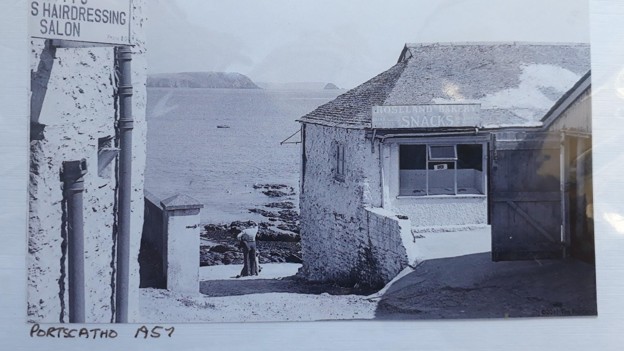
Tatum's Beach
Tatum’s Beach in front of the village was our playground.The amount of sand, seaweed and exposed rock varied with the weather. During the summer months the beach was popular with families, they would turn up mid morning, if the tide was out, they set out their towels and picnics on the sand and settled down for the day.
They didn’t know that us kids had got out early. We got into the rocks at the top of the beach and scavenged out the rock pools and built sand dams across just below the rocks.The dams were gradually filled by the freshwater streams coming out of the seawall above.
We then scarpered and hung out in the field above and waited watching over the wall..
Eventually the dams filled to the top and burst. A cascade of water flooded down the beach, the visitors had to grab their towels and belongings and hurriedly move across the beach.All good fun!
We all swam off the beach, unfortunately there was a raw sewage outfall pipes on each side of the beach.The water quality was terrible, we always had sore throats and upset stomachs.
The only plus side was the sewage attracted the fish. My father made a spear out of a 20 foot galvanised pipe with a steel barbed end. He would wake me up at 6 ish on a quiet summer morning when the water was still and glassy. We would go out in the boat, not rowing, just punting along using the spear over the sand to the Pit. Father had keen eyes,he could see the outline of flat fish just buried in the sand with only its eyes showing. We used to catch Flounders, Plaice, Dabs on a good day Turbot. There were plenty of fish,very unusual to go home for breakfast empty handed.
North Parade and the Social Club
Back up to the junction turning right into North Parade, passing the on the right was a Cinema run by Bill Curtis and the Men's Institute with two full-size snooker tables and reading room, managed by my grandfather Victor, later becoming The Social Club ,
These buildings were donated to the village by John Collette Thomas of Trewince. In the late 1800’s .The buildings have evolved for the good of the locals.
In my time, they moved the snooker tables to the basement of the cinema, opening the cinema room as a general activities/table tennis/Bingo hall area, with a youngsters coffee bar under the stage area at the front.. (The coffee bar was run by the youngsters and that's a whole story of its own!) The original snooker hall was changed to a two roomed bar area, the fishermen who were making their crab pots, mending nets and storing their gear were moved out of the basement, to make way for the bar cellar and toilets.
Later when the young people in the coffee bar became 18 and could drink, a ’Bilges Bar’ was built at the rear of the basement and legends were created. We drank a lot of ‘Boys Beer’, so called as it was the weakest alcohol level available, at 1s and 4p a pint (9 new pence). We sang a lot of songs (mostly rugby ) . Arthur Gearing then Rory and Guy Pawson manned the bar. What a time!
Memories of the Bilges Bar
I digress here as The Bilges Bar evokes numerous notable memories and friends.
One very notable to me was Tim Simon. Another regular Summer visitor, he did have an influence on several of us.
Bill Harris attended Southampton Technical College and studied Construction Engineering and knowing Tim they shared a flat together in Raymond Road Southampton.
One summer evening after Bilge's closing time, we were leaning over the Lugger wall and Tim said to me, ‘’I'm on a brilliant course of Naval Architecture, no-one ever fails’’ That’s for me I thought, and later signed up. Tim graduated and I took over his flat with Bill.
The summer after College Tim sailed his old double ended converted lifeboat’ Bonsaute’ from Hamble to Portscatho, taking weeks and closer to France rather than England at times. On the evening he arrived on his boat there was a huge celebration in the Bilges Bar. A lot of ale was consumed and as throwing out time approached, Tim, who was sitting in the back corner, sneaked an old type pressurised soda syphon off the bar and put it up his shirt with just the spout sticking out. He then caught barman Rory’s attention and ordered a double ‘bloody Mary’, slurring ‘’If you don’t serve me I might be sick all over your floor’’ so the whole bar could hear. Rory poured the drink and gave it to Tim. A few minutes later Tim leant forward, pressed the soda syphon against his chest which spurted all over the floor!! The whole bar bolted for the door to get out, Tim was left apologising and laughing profusely. We all saw the funnyside.
Another after Bilge's drinking evening the gang were all on the Lugger wall making a bit of racket ( there had been ongoing complaints from residents about late night noise) when we spotted the local policeman coming down past the Plume. Being locals we knew the score and most of us hopped over the wall by the Fishermen's Shelter onto the grassy bank and hid behind the wall. Tim was oblivious to this, he was confronted by Mr.Plod. First asked his name which he replied correctly ‘’My name is Tim Simon’’, to which he was asked ‘’what’s your surname’’ again he said Simon, the policeman was now getting annoyed and asked where he lived. To this, Tim pointed out to the darkness in the sea (the Pit area where his boat was moored.} and said ‘’Out there’’ This even more incensed the Policeman who threatened to lock him up for the night. To this Tim replied’’ Don’t be silly I know you haven’t got a jail!!’’ We were all giggling below the cover of the wall and eventually came up, the situation was diffused with a very stern warning.
Yet another evening after the Bilges turnout, rumour spread there was a Barbeque on Towan Beach. We all piled out of the Club and drunkenly got into various cars and drove off to Towan Beach . On arrival, abandoned the cars in the carpark and walked across the field to the beach.
Half way we met Tim in his Triumph Herald convertible carrying a few passengers, he was in the middle of the Chest high corn field.. He was lost, the car roof was down so we all jumped up on the back and set off through the field, lights on and the corn parting like waves, with no vision, until we hit an iron fence running through the field and came to an abrupt halt.
Passengers everywhere and on reversing found the front valance of the car was bent under and rubbing on the front tyres. This was soon pulled back into shape. Luckily, as we walked a few more yards through the corn we had stopped very near the cliff edge with a 30 foot drop onto the beach and the barbeque. The next day the farmer wanted to know who had flattened his corn, and there parked on the Lugger was Tim’s car with straw hanging off every corner of the bodywork! Walk through the past (1) (2) (…
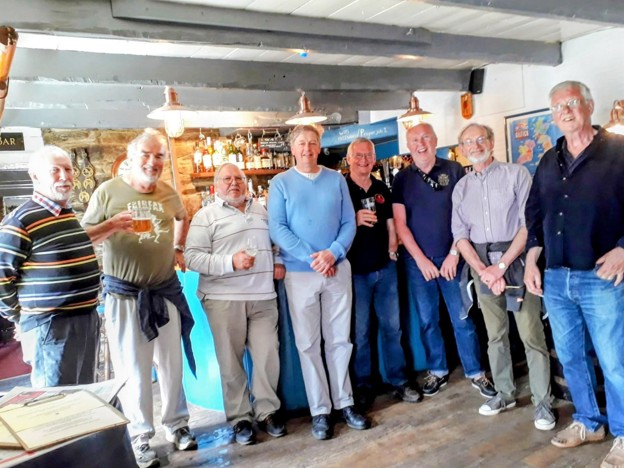
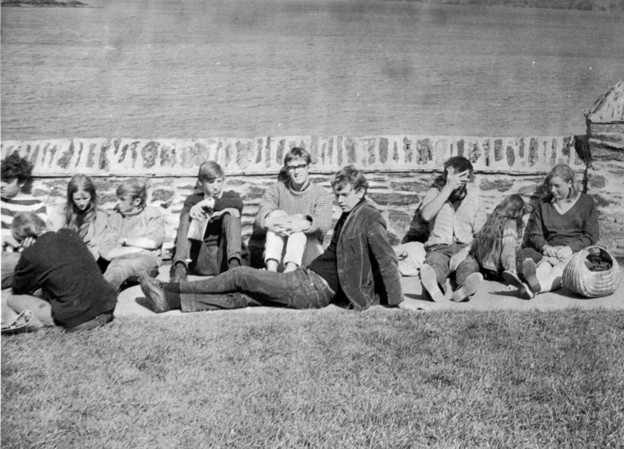
L to R. Goeff Tomlinson. Guy Pawson. Brian Davis. Gavin Carter. Tony Tomlinson. Bill Harris. Tim Simon. John Peters. At the Bar in the Plume of Feathers.
Back to North Parade
Back to my village ramble. At the beginning of North Parade, on the left was the book shop of ‘Scratchy’ Evans and then a row of old cottages opposite the Social Club door.. Dyer Manear lived in one, he helped his father run a little pig farm half way up Gerrans Hill where the Memorial Hall car park is now. In the latter days Alun (Oysters) Davies, an apprentice to Teddy Harris on the Percuil Oyster Farm, came to lodge with the Manears. Alun foolishly took on Scruff O’Toole one in the evening in the Social Club bar to a drinking match, a lot of rum was consumed and Alun ended up very worse for wear. He had to be carried across the road to his digs, wrapped in a duvet and abandoned.
Next on the right were some old stone and cob pilchard cellars/warehouses /stores now demolished for a block of holiday flats.
Back Lane and Sunnyside
On the left is the turning up to Back Lane/Sunnyside cottages. Up the lane on the right lived Russel Symons, a train enthusiast, can’t remember why, possibly his father worked in Truro at the Train station. Next to him were the delightful Rosemary (Rose) and Margaret (Maggie) Penrose.
At the top of the lane on the left is the back of Oxenberry's shop. The bakery wall backed onto the lane and was always really warm from the heat of the oven, great to lean against on a cold day, Just above that is a corrugated steel clad shed, under which the shop stored their paraffin with general stores over, I remember it well as my father and I built my Enterprise sailing dinghy in there, which when finished only just fitted ,on its side, through the door and down the steps.
Opposite the shed was a cob walled orchard, good for scrumping apples and above that a strip of scrub land under the top road (Clifton Terrace) retaining wall, it had two lone apple trees, only one of which used to fruit. The lane ends in a set of steep steps in the wall up to the road.
Along North Parade
Going back down and turning left along North Parade on the corner is a big house called Trosvik, this was a private School run by Mr. MacGregor for the more affluent pupils of the parish. When the school disbanded it was bought by the Dutfield family. Mr. Harry Dutfield owned Axminster Carpets, he had married a local lady and their son Simon who took over the business was a regular visitor. Harry was a boating enthusiast and bought a 36ft. Fishing boat which was skippered for years out of St.Mawes by Lawrence( Scruff) O'Toole.
Next along the Parade is a row of what were considered big detached grand houses with well tended front gardens behind neat stone walls and gates. The road at this time was a stone and gravel track with more large puddles than track.
On the right was an open field with a Tamarisk tree at the bottom, dares were made to see who could climb the furthest out on the branches over the seawall with the rocks below. A pair of massionettes were later built in the field, one became the base for John Foster's ‘Roseland Sub Aqua and water ski Club’. ( Another separate story).
Type Then next to the field was one of our favourite places.. The ‘Old Buildings’, these were the ruins of what was the Coastguard/Preventive headquarters, but then a jumble of tumbled down cob walls, this was our favourite playground, for building camps and making miniature road ways for dinky toys and general messing about. Now it is another terrace of massionettes, but they did build an extension on the back of one which became the village Barclays Bank. One of the maisonettes was a holiday home for Arthur Peters whose daughter Jane and son Robbie visited every year. Robbie came to live permanently after he retired.
At the end of the big houses on the left was an op-way/path which went straight up to Gerrans. Opposite this path on the seaward side is Waters Edge,one of the oldest and quaintest detached houses in the village, set in a large garden right on the cliff edge, in the summer Penny and Diana Peters whose father Dennis who was Arthur Peter's brother would come and stay. In the lowest part of the garden they had a large patch of Gunnera (giant rhubarb) which was our rain protection when playing in the old buildings next door.
Shute Meadow and the cliff road
On the right was a row of two semidetached houses, Micheal Murray lived in the last one, a real character who was always finding trouble. He managed to pull a pot of boiling water on himself, he was proud of his scared chest. He also managed to turn over ,on a straight road by Treluggan, his Ford Perfect with a gang of us inside, rolled it back upright and carried on!
Moving on along North Parade on the left was an open field occasionally used for cows, called Shute Meadow. On the side of the road/track coming out of the hedge from the field was a cast iron pipe, the stream of water was frequently used for domestic drinking as it was so sweet, no fertilizer run-off in those days!
Behind the shute in the bottom of the field was a large round water trough for the cows. The pond was covered in duck weed. One day my cousin Brian Davis and I were playing in the field and a local cat came past. I tried to pick it up but it jumped from my arms and landed in the pond, Brian , quick as flash leapt to the rescue falling headlong into the weedy water. I totally got the blame when he went home soaking wet and covered in duck weed.
Just across from the water shute was an old cottage which had been vastly extended and modernised as it sat in a premier site right on the cliff edge.Hidden behind high white washed walls but with a glass frontage overlooking the sea .
Annadale and the end of the road
Next along was Annadale, home of the Gill family, the father,Jerry was the Postmaster in the post office at the top of the Porth slipway they had two sons Peter and Simon. Annadale was built on the top of the cliff which was prone to erosion and there was an ongoing battle to build sea defenses on the rocks below.
Just the other side of Annadale was a layby which was the end of the road before it narrowed down to a cliff top footpath. The layby was created by the local refuse lorry which used to reverse back to the cliff edge and dump its contents down the cliff to the rocks below, unthinkable today, the tide came in and washed some of it away. A new refuse dump was later procured down the road past Treloan. However as kids we could scavenge on the beach and find all sorts of treasures stuck in the crevasses of the rocks and in the sand, you probably still can!
The Coastguard terrace
High above the layby was the imposing terrace built for the Coastguards to replace the original ones on Clifton Terrace, the Coastguards long since despanded, now occupied by local families.
I remember the Teague family at the end of the terrace, local builders, then there was the Holm family, notorious for Thora who was Terry (Bomber)’s mother. Bomber worked for the Teague brothers mostly caretaking and odd jobbing/building at Rosteague Manor. Bomber was a huge lad who got his nickname for his jumping off the Porth breakwater and making a huge splash. Bomber went on to become a local legend and character, a competitive sailor and celebrity.
Then there was the Pascoe family. Mum Renee running the Ways Bakery shop, father Hartley had a box backed haulage lorry which doubled as the local Coastguard Rescue transport, he later became steward in the Social Club.They had daughter Jenny and son ‘young’ Hartley.
Both of them went away to London to work, Hartley was instrumental in introducing us all to the fashion of the sixties; especially Levi Jeans and the world of the top rock bands. Later they both moved back to live in the village and work in Cornwall.Jenny a Human resources/Employment guru and Hartley with his own Optician Practice in Lemon Street, Truro.
I think in the next house possibly was a branch of the Neal family, evacuees from London in the war who settled in the village.
Back to the Plume of Feathers
Retracing my steps back to Johnson's shop back towards the Lugger, opposite the shop was the home of the Collins family with two sons, Tony and Robin, both became airline pilots and superb yachtsmen, their house backed directly onto the Plume of Feathers.
The landlord in my time was Bill Edwards who took over from my Grandfather Victor when he had to sell out to St Austell Brewery. Grandfather went off to fight in the First World War and when he returned in 1919 having left my grandmother in charge found she had been over entertaining the troops stationed at St. Anthony and there was very little money left but they struggled on, until the roof of the pub was in desperate need of repair so Grandfather eventually sold up in 1930
Bill Edward’s son Bob was a talented boatbuilder and engineer. I remember he built an iconic speedboat (Yeti) driven by a converted car engine in the pub cellar which was under the’picnic room of the pub on the left going up River Street.
When Bill retired from the Pub the Thomas family from Wales took over. They had two sons Chris and Graham. Father Roy Thomas soon departed and his wife Joan was left in charge, after that it was left to Graham to be the Landlord, I think staying for a record time as a tenant for St.Austell Brewery.
Apart from the Bilges Bar the Plume was the main meeting and drinking venue when you were legally old enough, you couldn’t beat the system as everyone knew your age.
Below is a photo of a random selection of drinkers at I think Celia’s birthday in 1969.
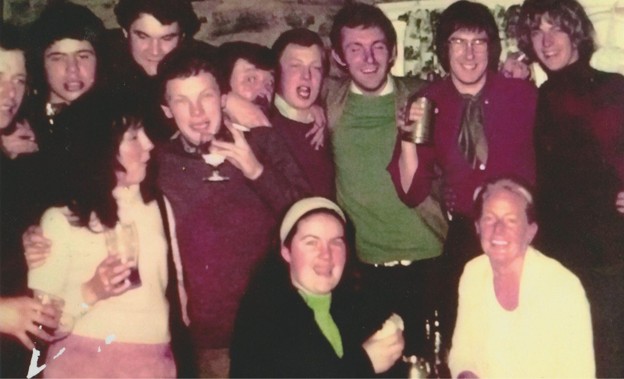
From the left to right… Rob Curtis (just in shot),Nigel Nicholls,Sue Law, Clive Cudmore, ChrisThomas, Tom Smith, Graham Thomas, Celia Carter, Geoff Counsell, Me-John Peters, Mrs Diana Carter, Gavin Carter.
The Village Square
At the end of the Lugger Road was Leslie (Dilly) Dunstan's house, he was a mentor to the youngsters. He had a good sized sailing boat in the Porth which he used to take out visitors for a sail and mackerel fishing trips. When there were no trippers he would get us onboard and take us out, he taught us fishing, sailing, boat handling, ropework and wise life lessons, a good man.
Straight opposite the front door of the Plume lived Paul Miller, a very quiet lad who didn’t mix with the rabble, and then The Wishing Well Cafe (Boathouse) where we could get Fish and Chips takeaway on a Friday night.
Above the Cafe in the village Square on the left is Wellington Terrace on the right was a tiny shop selling newspapers owned by the Hobbs family, daughter Pauline used to babysit me. Right at the end lived Micheal (Hookey) Walker whose Mum Barbara held notorious late night parties. Micheal was always a ‘hail fellow, well met’ sort of chap.
Back in the square at the highest side is a small house where the Chaffin family lived. Doug and Sylvia had two children Judy and Phillip (Chiff). Doug Chaffin was a local builder and became notorious in the Falmouth Harbour for racing a Sunbeam class boat ‘Jenny’. Attached to their cottage is Dormer Villa, a grand house with a veranda along the front.
Dormer Villa ( Previously Albert Villa built by a master mariner and ship owner Captain John Henry Nicholls) now occupied by the Crewes / Nicholls family. ( now a second home)
In the summer months, Nigel Nicholls and his sister Anne would come to stay, later Anne and her retired parents moved back to the village and built a house in Highertown.
At the end of the Villa they had built Dormer Stores, a split level general shop. Now an Art Gallery.
Oxenberry's and Pomfreys
Directly adjacent on the other side of the square is the Oxenberry’s the largest store and bakery in the village selling everything from groceries,fresh bread, hardware,clothes and beach spades, My family the Peters were intertwined with the Oxenberrys They had run the shop for years and presumably had no time for children, so when there was only a couple of them left they had to sell the shop, there was a brief time when Myself and cousin Brian were in heavy discussions as to whether we should take it over, how different our lives would have been if we had! It wasn’t for us at that time and the shop was sold and the Oxenberrys lived out their lives in the big house still attached to the shop and the top cottage in Sunnyside.
Just below Oxenberry’s was the Pomfreys Butchery shop where huge fresh meat carcasses could be seen hanging on hooks behind the counter. Home made sausages, eggs and wild game are all available with old style sawdust on the floor. (Now an ice cream parlour)
The Village Pump
The village square, the centre of the village in my day was, and still is, a carpark. The village hand pump had been moved from the centre to a spot beside the pub wall, but you could still see the opening position in the pub wall where a wooden water trough entered the pub to provide water from the pump to the in-house brewery which my grandfather operated. There was, hanging on the pub wall, a brewing notice tendered by grandfather to the authority in Falmouth to declare the amount and specific gravity of each brew.
Taking the road from the square uphill out of the main part of the village was another small shop on the left run by the Morse Family whose son is Lionel (Mouse) .
I remember being sent to the shop to purchase paraffin for our house heater..
The shop was set in a cutting below a small park above with a sluice grated drain underneath. From this drain the water disappeared, presumably into a pipe and ran down under the Square, down River Street and Horse Slip, it always perplexed me where it came out on the beach.
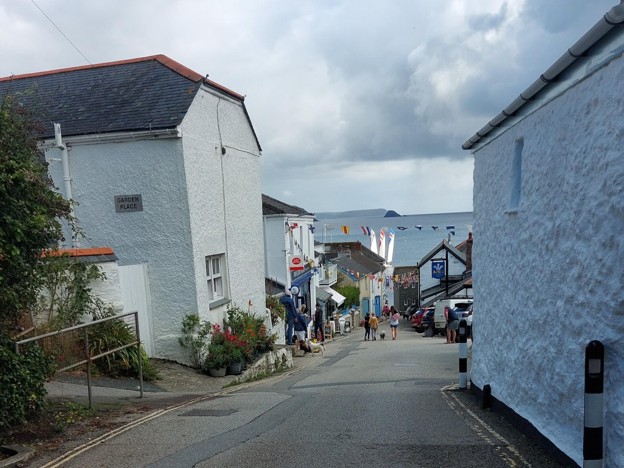
Highertown
The face of the cutting opposite Morses Shop was covered in hanging ivy. This was our braking system when coming down the steep hill on our trolleys (Butts as we called them). Made from old pram wheels which we foraged from the Council Dump and fitted to a plank of wood, the front wheels swivelled to steer. If you were brave, you went head first and steered with your hands, if not, you sat on, and steered with your feet. You pulled the butt up Gerrans hill as far as you dared then jumped on and pelted down the road to opposite Morse’s shop where you steered into the wall, grabbing a hank of hanging ivy and coming to a halt ,hopefully without injury. Not many cars were around in those days.
Above this is the turning down to Highertown, On the right lived the Harbour Master, Morley Billing and opposite was the Cobbler shop in a small rectangular building up a small flight of steps,. The shop was run by Graham Crewes. He was a powerful young man who actually made and repaired shoes. The smell of leather in the shop was fantastic. We used to go there just for the smell and to pester Graham to make us real leather flip flops rather than wear the plastic ones from Oxenberry's which always broke. Graham had our admiration, as he used to have a rowing dinghy which he used to put on his shoulders and carry from the Porth up to his shop and back down. He emigrated to Australia and the shop closed forever.
Down the slope at Highertown was in Alvin Wright’s and Bill Curtis’s garage and petrol station, always busy and always remember the huge glass carboys just inside the door, which I assume held distilled battery water. Outside a couple of petrol pumps and those round Castrol Oil signs in a frame which spun in the wind. Always wanted as they made brilliant snow sledges. In latter years the garage was taken over by Tom and Celia (Carter) Smith.
Outside the garage facing the road were large corrugated sheds used to house a local bus and Hartley Pascoe’s lorry, Now the site of Anne Nicholls’s house. Opposite the garage was Teddy Harris’s bungalow; he had a daughter Sandra.Teddy had a lovely boat in the Porth named Boy Ted and he ran the Oyster fishery at Percuil, taking on an apprentice, Alun Davies.
A dirt track beside the sheds led to the quarry which had provided most of the stone for construction of the village, now occupied by Nicholls and Nicholls general Builders and Carpenters workshops. Built in the quarry base under the towering rock face.
My father being a retired Shipwright was frequently in the workshops getting bits of wood for diy or repairing boats.
Back to the main road which leads from the village square straight up hill to Gerrans Churchtown.
Clifton Terrace
Across the junction at Highertown around a hair pin bend onto Clifton Terrace and New Road.t On the hairpin the road had been cut into the field above creating a steep bank. On the top of the bank it had overgrown with scrub ,and small trees under which we discovered a warren of openings where we could hide out and watch the people and activities below without anybody knowing we were in our ‘camp’ above. One day whilst foraging around in our ‘camp’ I found a full size officers ceremonial dress sword, it was a bit rusty but I was the envy of the co-campers. I’d be arrested today for being in public with a dangerous weapon! I can only think it was discarded by one of the Coastguards who lived in the next row of Original Coastguard cottages adjacent on Clifton Terrace.
Back on the road after the hairpin are the original row of Coastguard Cottages, Clifton Terrace. The first one on the corner was occupied by the Richards family, they had a son Robert who I taught to sail his Cadet dinghy at Percuil. Next door was my Auntie Rhodda Moyle and then the Cudmore family. Sid the dad was the local Western National bus driver doing the run to Truro everyday, they had three children, Clive,Carol and Celia.
Next to them was Bruce Tilton and then the Davis Family in Gran-Vue.
Gran-Vue and the Davis family
Venning and Lillian Davis had four daughters, Vera, Ruby, Pearl and Betty. Vera was my mother and I was born in the house. Brian’s mother was Pearl. Ruby married and moved to Hampshire and had three daughters Susan, Gillian and Lynn. Betty was the local ladies hairdresser.
This small house was occupied during the war by the Davis family of six, plus the evacuee Neal family from London of about four, a bit of a squeeze! Until the Neal’s and my family were allocated alternative permanent council housing.
Venning was a carpenter handyman who built an extension to the house on the side over the garage /workshop. As was the norm for many families in the village, they moved out of their house into sheds,caravans etc. so they make some money renting out their home to summer visitors which the extension was used for, later converted to become Betty's Hairdressors salon after she was moved out of her salon under the Social Club.
Unfortunately my Grandmother Lilian died early of cancer, My Cousin Brian stayed in the house, which was my second home,and Brian and I grew up as brothers .
Brian moved away to Hampshire and worked with Ruby and her husband Alfred in his building and construction company, the lure of home eventually got to him and he came home working with a friend from Grammar school, Johnnie Williams for Haven Leisure which took him off to North Wales then back home to work for Electrical Wholesalers in Truro before starting his own Electrical business in Truro.
Brian married Melanie and had four children, Deborah,Tim Nick and Lizzie. To accommodate the family he built a grand house in Gerrans.. Later selling up when the children left home and moved back to Gran-Vue completely modernising and refitting the whole house. Walk through the past (1) (2) (…
Clifton Terrace
The house next along Clifton Terrace was occupied by a reclusive lady, Mrs. Westlake. She would shout at us kids and frighten us away, the house was always in a state of needing repairs and the garden overgrown with the curtains drawn, we kept well clear.
Next door were the Raspbisons, they had a grandson who lived in Penryn and he was dispatched to stay with them for the summer holidays. Derek (Rassie) was always teased by us locals, he would hang around the Porth trying to ‘cag’ trips on the boats and join in with the throng, who were pretty horrible to him most of the time. But I think it was still much better than Penryn.
Then next door was the resident Policeman. They changed periodically as they got to know the locals too well. The house had a small lockup ‘jail in the back, Luckily none of us ever got to see the inside.Don’t know it was ever used in anger.
Clifton House
At the end of the Original Coastguard cottages on Clifton Terrace was Clifton House built by a sea captain called Lower, a detached house used by the Carter family as a guest house. They had three children, Celia, Gavin and Roger. We used to sneak up the side lane and into the back to the kitchen where there always seemed to be tasty cooked treats available. They were the first family we knew who had a black and white television and it was really exciting to cram in the front room and watch this new invention. I remember watching the serial ‘Quatermass and the Pit’.It scared the life out of us all, we had to run home looking over our shoulders!!
Eschol House and New Road
Beyond Clifton House was an even grander mansion ‘Eschol House’ built by Captain Crewes, another sea captain named after his ship. This had become a hotel and was very successful and employing locals and summer casuals. Now a Nursing Home, leaving the village with very limited that style of visitor accommodation.
The road used to terminate at Eschol and was extended straight out to meet the road running from Trewitian to Gerrans at Tregassa Farm. This was imaginatively called New Road. This road opened up for a large post war development.
The seaward side of Clifton Terrace had no buildings allowing uninterrupted views of the bay, except one built opposite the Eschol car park entrance. ‘Cranmere’ was built by the garage/Cinema owner Bill and Bertha Curtis. They had three boys,Barry,Gerald and Robert.
Rob was in our gang and was fanatical about football and spent hours kicking a ball around with dreams of being a professional footballer until he discovered girls. Barry emigrated to Canada and Gerald became a teacher. Rob tried teaching in London, but it didn't suit him, he came home to become a successful commercial fisherman, then a goat farmer, now an equine farmer.Not afraid of hard work!
In the summer the Curtis family all lived in the basement of Cranmere and let the house to visitors. One of the regular families to stay every year were the Tomlinsons from South London. They had four children, Barbara,Tony,Geoff and Margaret. In later years the whole family moved to the village and Tony and Geoff spent many years commercial fishing.
Springfield
At the start of New Road open farm land, the first field called Springfield which gave its name to the Council development constructed by local builders.
The first two semidetached houses built were on elevated plots with magnificent sea views. Allocation of these new houses was prioritised to ex, service personnel with children. My father was still serving in the Navy and we were living with my mothers family and we were privileged to get No1. Next door No2 went to the O’Toole family. Mr. O'Toole, ex Navy, was headmaster at Gerrans CP school with four children, Yan, Bridget Lawrence and Kevin. Lawrence was eighteen days older than me.
Mr.O’Toole was a big influence on many of our lives, teaching us from age five ,( and as there was no secondary school at that time for us to go too, us numpties who failed our eleven plus just stayed on at primary school until we were sixteen. Then had the option to go to Cornwall Technical College in Camborne to study O and A levels).
Because of transport logistics we had to lodge in boarding houses all week and come home at weekends. Great, away from home from sixteen, we grew up quickly.)
The next pair of houses were taken on by The Gearing family, the two sons, Peter and Handley,who were older than our lot, and next to them the Rowe family. Micheal and his sister Jennie who were younger than us.
The Council House development continued along the road until it was at the rear of the new Coastguard houses, Admiralty Terrace.
Treventon Road
At that point another road of Council Houses, Treventon Road, swept up across the fields, but strangely it never quite got to meet the Gerrans road at the top.
On this road we had Keith Brown on the bottom corner, Irvin Green next door.
John Billing, Morley's son and talented boat builder. He perfected the art of using plywood planks for making lovely clinker rowing punts for the Porth, he made two Merlin Rocket racing dinghies for his cousin Bomber and several carvel inboard motor launches. Most of them built in a corrugated steel garage on the righthand side of New road owned by the lovely house of Nanshute.
The Couch family ,Patircia and Karen,lovely girls |who both stayed in the village being stalwarts of the community.
Also the Harris family, Mrs. Harris who was the District Nurse and Mr. Harris the local Postman. They had two children Jean and William (Bill). Bill was one of our main instigators of activities and trouble we all got into. He was my flat mate at College, we sailed dinghies together, was my Best man at my wedding and have kept in touch ever since we were boys growing up together. Bill studied Construction Engineering and had a successful career ending up living in London.
Opposite Bill lived the Collins family, Dad Charlie was a boatman in the Porth and we all called him Captain. Just round the corner down a branch road lived Graham Robbins (Gertrude) not part of the gang and unfortunately subject to our unwarranted teasing. Near his house was the new Rocket Station where the Cliff Rescue squad kept their equipment ready for instant callout.
Beside the spur road was a tall block rendered tower, probably twenty feet high, on top was a huge steel water tank which provided water pressure for the estate below.
Treventon Road ended in those days just above the Council bungalows on the left, built for the older locals. Above this was an open field separating Portscatho from Gerrans and the pathway from Eschol House ran up the southerly edge to exit beside the Congregational Church in Gerrans.
Bonfire Night
This field was the site of the annual November 5th bonfire . We all spent hours searching around the villages for things to pile up in the middle of the field. Our ‘butts came in handy for lugging wood and rubbish to the bonfire. We also made stuffed ‘guys’ using old clothes which were wheeled around the villages weeks before bonfire night to collect ‘penny-for- the-Guy’. The pennies were spent in Johnson’s shop for fireworks.
We were very precious about our fire and how big we could make it. The big worry was that the ‘Gerransites’ would burn it down before the big evening. In later years peace was made and we all worked together.
Bonfire night was a big occasion, most of the village locals turned up and all our hard work with the guys on top went up in a blaze of glory. Everyone let off their fireworks and it was spectacular.
Growing up in the village
It is worth noting while growing up the boys all played football at school, on the streets and for ‘Gerrans Rapido’ all with varying degrees of success. In the summer, time was spent up on the Cricket Ground in Gerrans playing cricket (No-where near the hallowed centre pitches) Or, we were on the water in boats, on the beaches, and generally out all day with no supervision. Just coming home for meals and going again.
The Smokey Joes
A little older, a local band was formed called the Smokey Joes. Rob Curtis -vocals; Gavin Carter- drums; Bill Harris- Bass guitar; John Sykes- piano/organ; Dylan-Rhythum guitar;
The group had great success, backing lots of big named groups predominantly at the Carlyon Bay venue which was a huge ex seaplane hanger on the beach near st. Austell.
The pinnacle was probably when Hartley, who was living in London in a flat with Pete McDaniels the drummer of the ‘Birds’ to bring his band to the village and actually played in the Memorial Hall. The notable members of the band were Kim Gardner(then became Ashton , Gardner and Dyke ) and Ronnie Wood ( then joined The Faces and The Rolling Stones).
The Smokey Joes were very successful and were in demand to perform in many of the village halls. This gave the rest of us the option to accompany them for an evening out and about, being very sociable visiting other villages.
his did have its incidents. One evening at a gig in the Portscatho Memorial Hall the local ‘hard boys’ turned up on their motorbikes to be confronted by the construction boys that were building Treliske Hospital, one lot got a few beers in the Plume and the others in The Standard in Gerrans. They met on the dance floor of the Memorial Hall. All hell broke loose, to the point darts that had been lifted from the pub, were thrown at each other.The band had to stop playing and the Police called to break up the mini riot.
Portscatho and Gerrans
There was always a huge rivalry between the separate villages of Portscatho and Gerrans.
In Gerrans we had many friends, as we all went to the same primary school, namely… Micky George, Andrea and Keith Mallinson, Esca and Jock Wilson, Jane and Rickie Iddison, John Andain, Dorothy Dean, Leonie Pemberton, Chris Pollard, Arty and Stan Hooper, In the summer Judy and Sara Impy and just outside John Emmett at Tregassa, Steve Goodchild, Rick Stevens plus Pat and Brenda Yelland in Bohortha, John Badcock at Rosteague, Cynthia,Vivian and Gail Retallack at Methers Collyn, There was also John Mitchell who had a shooting accident and ‘Jimmer’ who had a huge 650cc motor bike which eventually was his undoing. Fatally crashing at Ruanhighlanes on his way to work. I never got on a motorbike since.
Gerrans School
Early memories of Gerrans are attending the Church every week for Sunday School. We could always think of alternative things we could be doing, but it did me no harm and gave me a broad knowledge of the Bible.
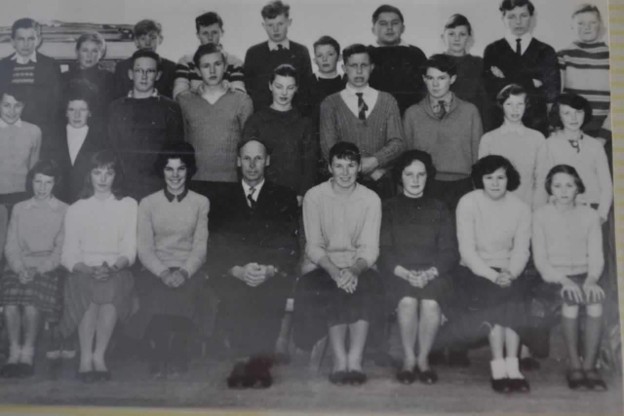
Gerrans County Primary school filled most of our informative early years. We all walked to school every day, rain or shine, no lifts in those days, and no Mum or Dad holding your hand.
The four class rooms with high ceilings were heated by anthracite coal burning stoves which, if the wind was in the east, filled the rooms with smoke. You kept your coat on in the winter as it was freezing.
The day started with assembly in the main classroom with a rousing hymn, followed by each teacher calling the register, this was closely monitored and you got a prize for full attendance.
Mid morning the milk in small glass bottles in steel crates was delivered and if it was cold to stop it freezing was placed by the coal stove. I don’t like raw milk, probably because the school milk by the time break for lunch came around was curdled in the bottle.
The teachers I recall were Mr. O’Toole head, Charlie Bunney, Miss Peasley, Miss and Miss Sprod the School secretary who sat on the low stage at the end of the main classroom.
We had a fairly good all round education and at eleven we took our Eleven Plus exams, if you passed, you went to St. Austell Grammar School by bus every day. Here the tribe got divided ,I was a failure and had to stay on at Primary School until either leaving and going to work, or further education at Cornwall Technical College. I didn’t mind staying on as most of my peers were doing the same and we had more time to run amok in the village after school.
Sitting at the back of the class,I was put in charge of ringing the school bell which was stored on a big welsh style cupboard which stored all the books on the rear wall of the classroom. Mr.O’Toole would at appropriate times, ask me to ring the bell to signify break times. One day I obviously wasn’t paying attention and I turned around and rang the bell. It wasn’t a break time and the whole school was in confusion. I was immediately sent to the other classrooms and sheepishly apologised and corrected the situation. I think I got ‘lines’ for my misdemeanour.Luckily not the cane which was still in use at that time.
Keith Mallinson
I ended up sitting on a double desk at the back right hand side of the big room. In front of me were Rob Curtis and Bill Harris. Next to me was Keith Mallinson from Gerrans, Keith was a great lad, he bought Bombers first roll-deck Merlin Rocket dinghy that John Billing had built.
Tragically one day Keith was sailing single handed around from the village to Perciull, on quite a nice day, they found his boat drifting with no Keith onboard, really upsetting.
Tregony and Cornwall Tech
In my last year at Gerrans all age County Primary School they built a brand new Secondary School in Tregony to serve the whole area .
Mr.O’Toole was appointed Headmaster and those of us still at school transferred to Tregony. thrown in with tribal enemies from Probus, St.Mawes and Tregony it was an interesting mix, as we were all at different levels of education and at this stage getting interested in the girls.
Because Mr.OToole knew me and appointed me Head Boy, I felt slightly above my station as I was surrounded by boys I didn’t really know, but it seemed to work out. Except when they got me in the boxing ring, as I wore glasses, when I took them off my vision wasn’t too good and the boxing gloves came at me faster than I could see them.
After Tregony it was off to Cornwall Tech following Bill Harris, Clive Cudmore and Rob Curtis into digs for the week, home to good old Portscatho at weekends. O'levels for a year in the old mine working buildings at Dolcoath and A'Levels for two years at Trevenson.
Type your paragraph here
The best of times
Having been born in the era of the end of the forties, along with many of the friends mentioned above, we are all now of an age where a lot of these memories will be lost and probably of little interest to those who are making their similar memories now. I can not help thinking we had the best of times!
Portscatho today
Like all Cornish villages Portscatho has evolved, extended and changed considerably. The problem of second homes is predominant. Thank goodness for the Council Estates and affordable homes built at the back of the village. These properties are not as attractive to second home buyers as they lack the quaintness and location of the original village. Because of the estates, Portscatho still has a vibrant local community who keep the place alive in the winter months and the lights on.