Warren Edwards Peters
1922–2004
Born at the Plume of Feathers in Portscatho on 19 March 1922, Warren Edwards Peters lived a life shaped by Cornwall, boats, wartime service, family and community. These pages draw upon the memories he recorded in his own words, preserving his recollections of a world that changed enormously during his lifetime.

A Portscatho childhood
Warren’s earliest memories were of life at the Plume of Feathers and growing up in Portscatho. He was the second child of Victor and Annie Peters, with his sister Bernice seven years older. The Plume was not simply where Warren was born; it was his family home and the centre of many of his earliest experiences. He remembered birthday parties held in the large Picnic Room, village characters coming and going, and a childhood surrounded by the harbour, boats and the sea.
I was born on March 19th 1922, a Saturday at 5am at the Plume of Feathers, Portscatho.”
Life at the Plume provided Warren with no shortage of memories. He recalled birthday parties in the large Picnic Room and a model of HMS Arethusa that fascinated him as a child. The model also connected him with an earlier generation of the family: Warren remembered being told that his great-great-grandfather had served aboard the ship before later joining the Packet Service, while his grandfather was eventually established at the Plume of Feathers.
Warren remembered a childhood spent around the harbour, on the water and among the boats of Portscatho. Summer was a particular favourite, with hours spent swimming and boating, while the annual regatta brought racing in local boats, rowing and swimming competitions, followed by singing and dancing.
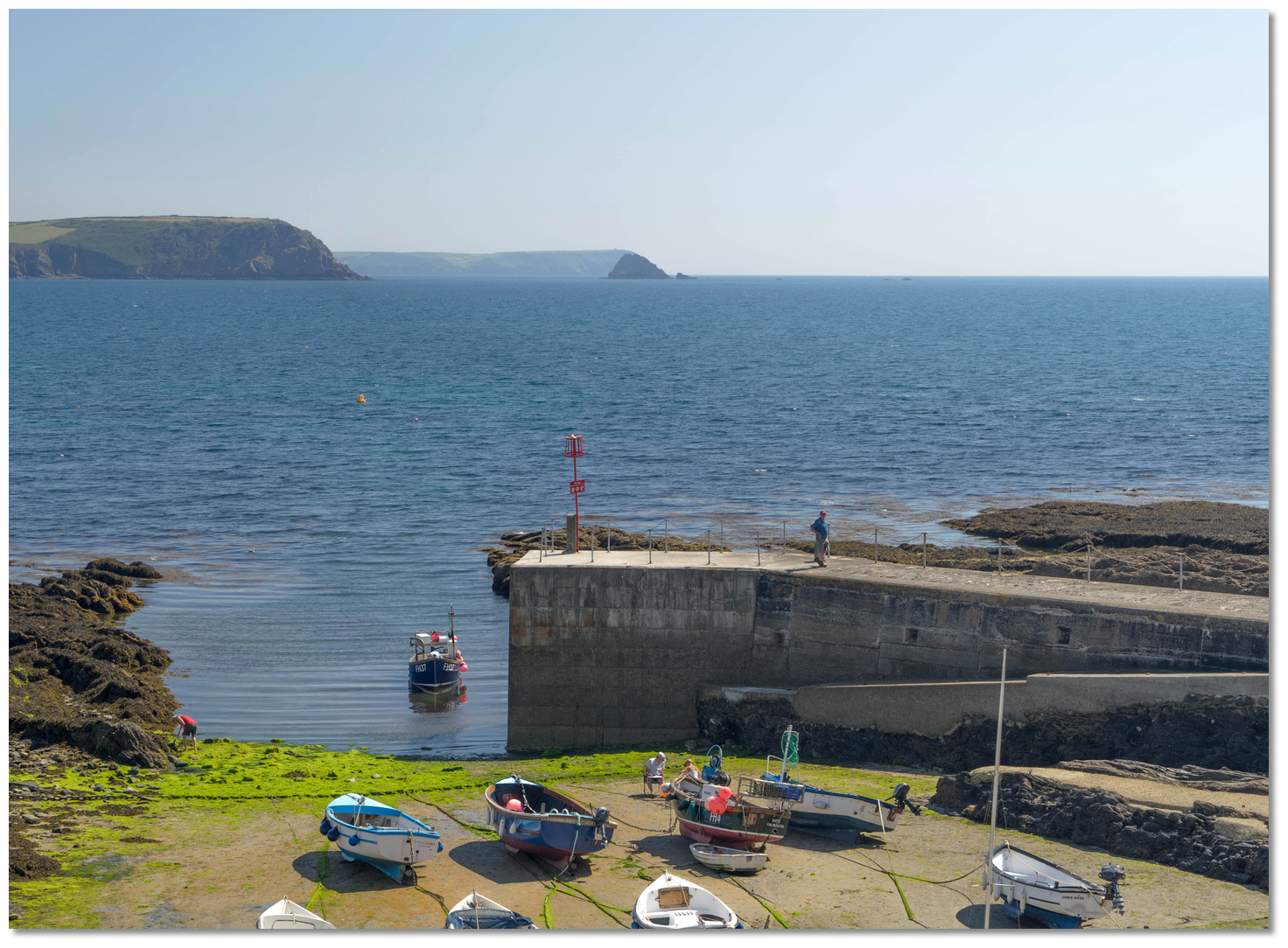
“We took a dressing table mirror out to Gull Rock, climbed Gull Rock to the top and stuck where the evening sun would shine back to the village.”
Warren and his friend Desmond Gearing were eventually spotted by the coastguard, Nobby Hall, who made them row the three-and-a-half miles back out to Gull Rock to remove the mirror. It was one of many adventures Warren remembered from a childhood spent around Portscatho, Gerrans and the sea.
HISTORICAL CONTEXT
Gull Rock
Gull Rock has a darker place in local maritime history. On 31 January 1914 the German barque Hera was wrecked there, with nineteen of her twenty-four crew lost.
Discover the story of the Hera →
School days were spent at Gerrans, where Warren remembered Mrs Corin and Mr Harding, football matches against St Mawes, and the Whit Monday sports. He was proud of being a fast runner and recalled winning medals against older boys.
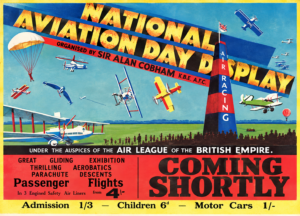
One of Warren’s most vivid childhood memories was the arrival of Sir Alan Cobham’s Flying Circus at Top Parks when he was about eight years old. The biplanes offered flights around Gull Rock and, for the more adventurous, the chance to loop the loop. Warren remembered his mother taking the more daring flight before he eventually went up himself with his sister Bernice.
I was so scared! and I remember thinking my mother was pretty brave
HISTORICAL CONTEXT
Cobham’s Flying Circus
Sir Alan Cobham's National Aviation Day tour visited Falmouth on 6 August 1934, when Warren was twelve. The touring air shows brought formation flying, aerobatics and passenger flights to towns across Britain.
Explore Cobham’s Flying Circus →
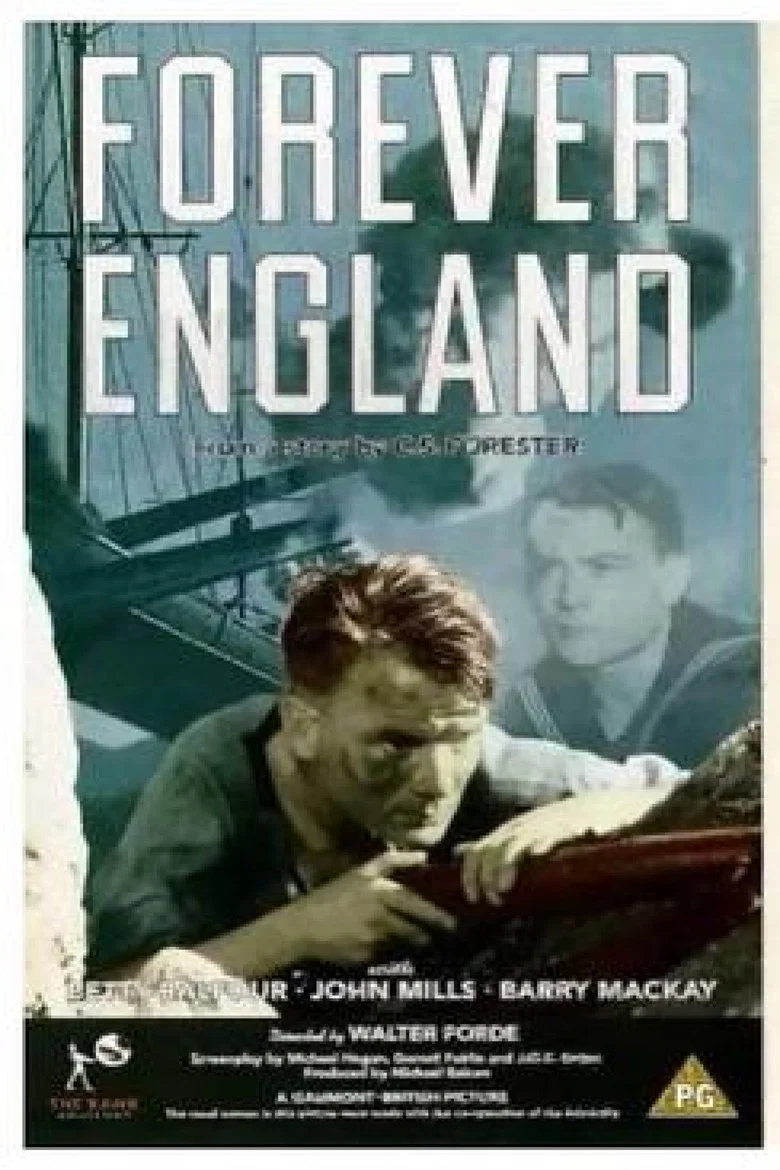
There was further excitement when the Gaumont British Film Company arrived to make Forever England, a naval film starring John Mills, Betty Balfour and Jimmy Hanley. Warren and Desmond rowed out to Gull Rock to watch the filming and soon found themselves helping the film crew, ferrying equipment by dinghy from Nare Head to the rock. Warren recalled seeing warships in the bay, including HMS Orion — a ship on which, remarkably, he would later serve during the war.
“Much to our delight at the end of the day we were paid the colossal sum of £5 — big money for two 12-year-old boys.”
HISTORICAL CONTEXT
CoForever England — 1935
Released as Brown on Resolution in 1935, the film gave John Mills his first leading role and was made with extensive Royal Navy cooperation using real warships. Mills would later become one of Warren's favourite actors.
Leaving the Plume and learning a trade
As Warren grew older, life at the Plume began to change. His father Victor’s health was becoming a concern and the building itself needed considerable work, including a new roof. With trade also changing, the family eventually sold the Plume of Feathers to St Austell Brewery, bringing Warren’s childhood in the pub to an end.
The family moved away from the Plume and Warren’s father later became manager of Trevose Golf Club. For Warren, meanwhile, the next stage of his life was beginning in Padstow, where he started an apprenticeship as a boatbuilder at Steve Brabyn’s yard. It was the beginning of a trade that would soon take him from the boats of Cornwall into the very different world of wartime shipbuilding.
“At 14 plus I started a boat building apprenticeship at Steve Brabyn's yard at Padstow at that time building motorboats and dinghy's etc.”
Warren might easily have followed a very different path. While living at Trevose he became a good golfer, and the club professional wanted to take him on as an apprentice. Instead, at fourteen, Warren chose boatbuilding — although the golf would prove useful years later during his travels with the Royal Navy.
Brabyn’s yard was a busy place. Warren worked on motorboats and dinghies, made heavy trawl doors for the Lowestoft and Grimsby boats that came into Padstow during the herring season, and helped refit old schooners including the Mary B Mitchell and Olive Branch. The yard also held the contract for fitting out RNLI lifeboats.
Steve Brabyn's yard at Padstow →
One of the most serious events Warren remembered from his apprenticeship involved the RNLI lifeboat John and Sarah Eliza Stych. Brabyn’s yard had recently refitted the boat when she was lost with almost all hands. A Board of Trade inquiry followed, and a buoyancy tank found in the yard briefly raised questions about the refit before it was established that the tank did not belong to the lifeboat.
Away from the boatyard, Warren remembered Padstow fondly. He played football for the local team — even scoring the winning goal in a cup match — and went to the cinema once a week, where there was always a scramble for the double seats at the back. When his parents moved back to Portscatho, Warren stayed in Padstow, lodging with Steve Brabyn for eight shillings a week and returning home most weekends.
By the end of his apprenticeship, however, war was approaching. Warren had always wanted to join the Royal Navy, encouraged by stories from other boys who had already left the yard to join up. When war was declared on 3 September 1939 he applied, only to find that the Shipwright Branch was full.
War and the Royal Navy
Unable to join the Navy immediately, Warren discovered that boats were being built for the Admiralty at Falmouth. He found work there constructing Motor Launches and Motor Torpedo Boats, returning to Portscatho with an AJS 350 motorbike and, by his standards, earning good money. The hours were long — starting at 7.30 in the morning and working through until 7.30 in the evening, including Saturdays and Sundays — as the yards worked to meet the demands of war.
“Back to Portscatho with a AJS 350 motorbike and went to work [earning] lots of money in my terms.”
The work at Falmouth brought Warren close to the war in a way that life in Portscatho had not. Men and women from the surrounding villages joined the yards, including several from St Mawes and Portscatho. Warren initially travelled across by boat and steamer, but the docks themselves soon became a target for German aircraft.
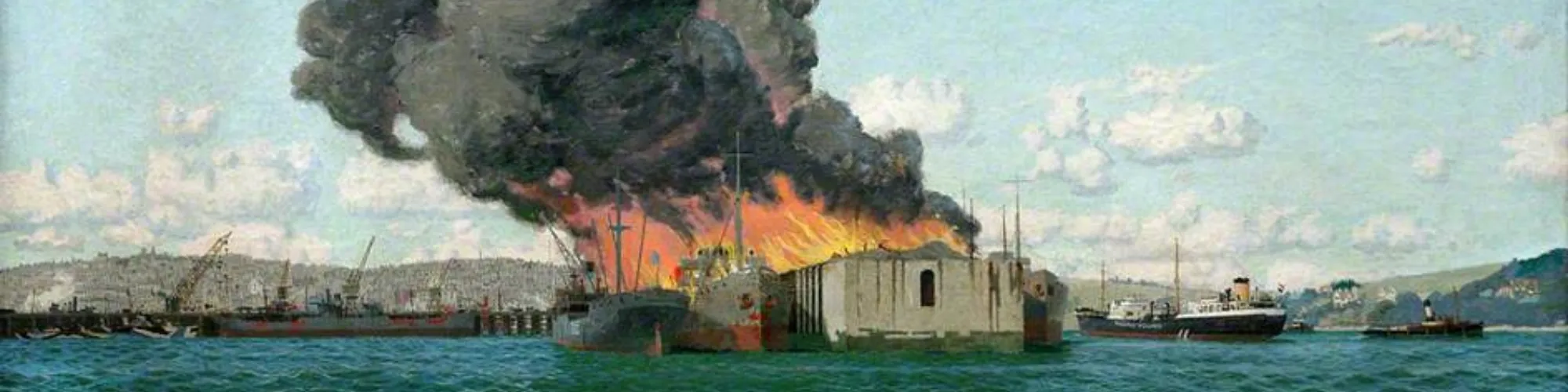
On one journey to work, the docks were bombed, hitting the tanker British Dominion and a Greek ship carrying cotton at the Northern Arm. The steamer immediately turned back to St Mawes — an incident Warren characteristically remembered not only for the bombing, but because it cost everyone a day’s pay.
HISTORICAL CONTEXT
The Falmouth Docks Raid — 1940
On 10 July 1940 German aircraft attacked Falmouth Docks, setting three ships ablaze at the Northern Arm. Warren remembered the tanker as British Dominion; contemporary records identify it as British Chancellor, alongside Tascalusa and the Greek cargo ship Mari Chandris. Ten men were killed.
“The steamer's skipper Ben Johns immediately turned her around back to St Mawes losing us all a day's pay.”
When German sea mines were dropped in Carrick Roads and water traffic was stopped, Warren and several other men from Portscatho found another solution. Arnold Nichols, Fred Nichols, Ronnie Teague and Warren hired the nine-and-a-half-ton yacht Nannette, moored off Ponsharden at Penryn, and used her as their temporary home while working in Falmouth.
One evening Warren and Ronnie were getting fish and chips on the Moor when German aircraft dropped a stick of bombs. One exploded behind Jacob's Ladder and hit a chapel being used by the forces, killing and injuring servicemen. Warren's description of what he saw afterwards is one of the more sobering passages in his memories.
Warren’s ambition was still to join the Royal Navy. With his boatbuilding apprenticeship and wartime work behind him, he eventually entered the service as a shipwright — a trade that would take the skills he had learned in Cornwall around the world.
HISTORICAL CONTEXT
The bombing at Jacob's Ladder
On 9 October 1940 a bomb struck Falmouth's Wesleyan chapel near Jacob's Ladder, then being used by servicemen. Five people were killed that evening and a sixth serviceman died from his injuries the following day. The chapel was badly damaged again in May 1941.
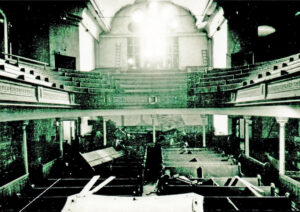
Warren had already volunteered for the Navy, but as the months passed he became restless watching friends leave for the forces. He decided that if the Royal Navy did not want him, he would try the Merchant Service instead. At the Shipping Federation Office in Falmouth he was accepted as a shipwright aboard the tanker British Tiger — but, being under 21, he needed his parents’ consent. They refused and told him to wait for the Navy. Warren later reflected that this was probably fortunate: the British Tiger was subsequently sunk.
Not long afterwards the call finally came. Warren rode his motorbike to Plymouth with George Sawle, who was joining the RAF, and went through the Navy’s medical, educational and trade tests. He was then sent to the training camp at Trevol, Torpoint, for basic training.
“Not long after that the Royal Navy found they couldn't do without me.”
After basic training at Trevol, Warren returned to HMS Drake at Plymouth, where thousands of men were being processed and drafted while the city endured nightly bombing. His first posting was to the French battleship Paris, which had been brought to Plymouth and was being used as an anti-aircraft ship in the Sound.
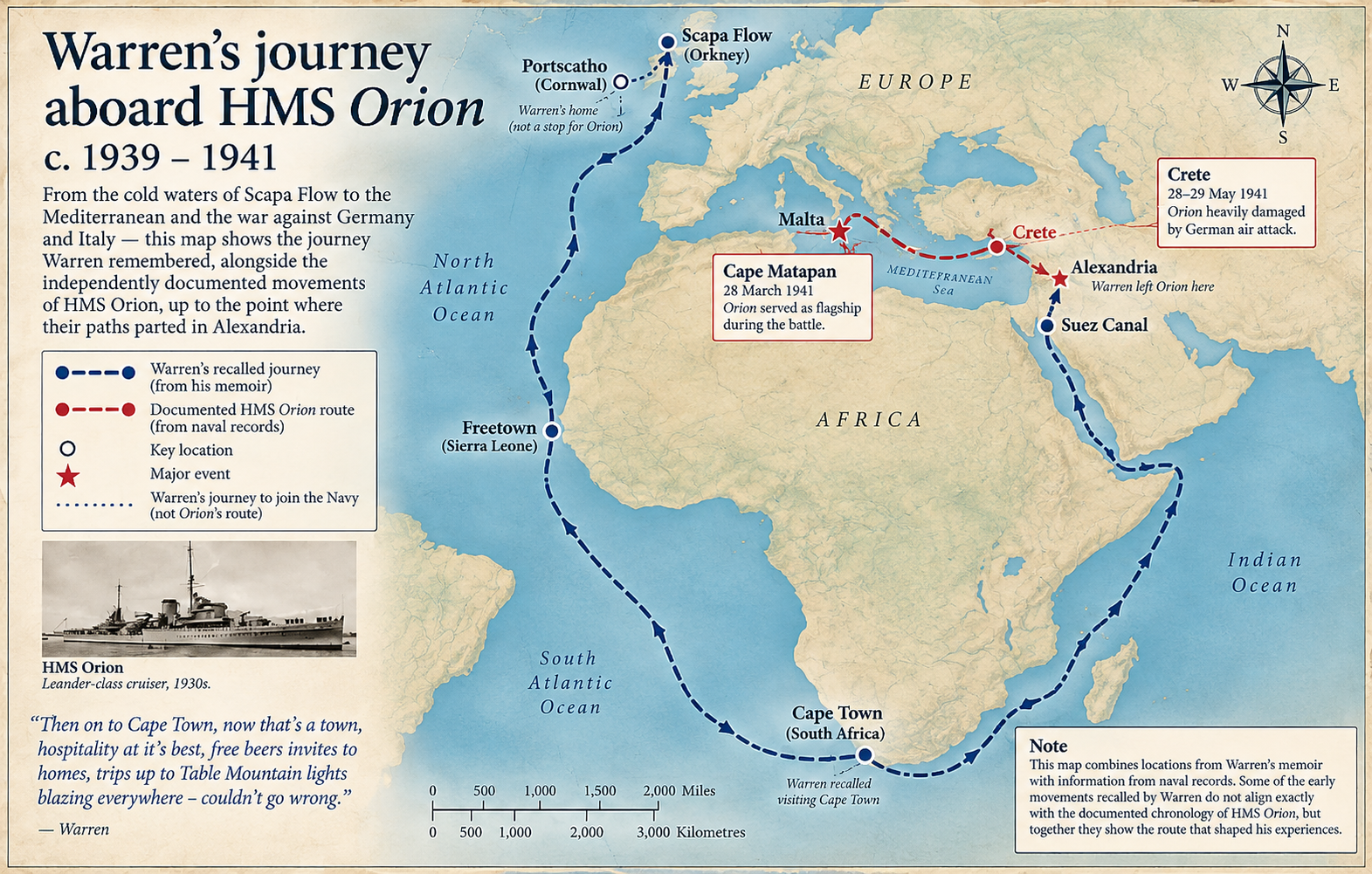
His first real sea-going draft was very different: HMS Orion, a Leander-class light cruiser already experienced in wartime service. Warren joined her as one of a team of six shipwrights, alongside a blacksmith and plumber. From Plymouth, Orion sailed north to Scapa Flow to work up before beginning Atlantic convoy duties.
Years earlier, Warren had watched HMS Orion appear in the bay at Portscatho during the filming of Forever England. Now, the boy who had rowed out to Gull Rock to watch the film crew found himself serving aboard the same ship in wartime.
At sea with HMS Orion
After working up at Scapa Flow, Orion began escorting Atlantic convoys. Warren remembered the first voyage, between Iceland and Newfoundland, as remarkably quiet — and remarkably boring — with the cruiser restricted to the speed of the slowest merchant ships in the convoy.
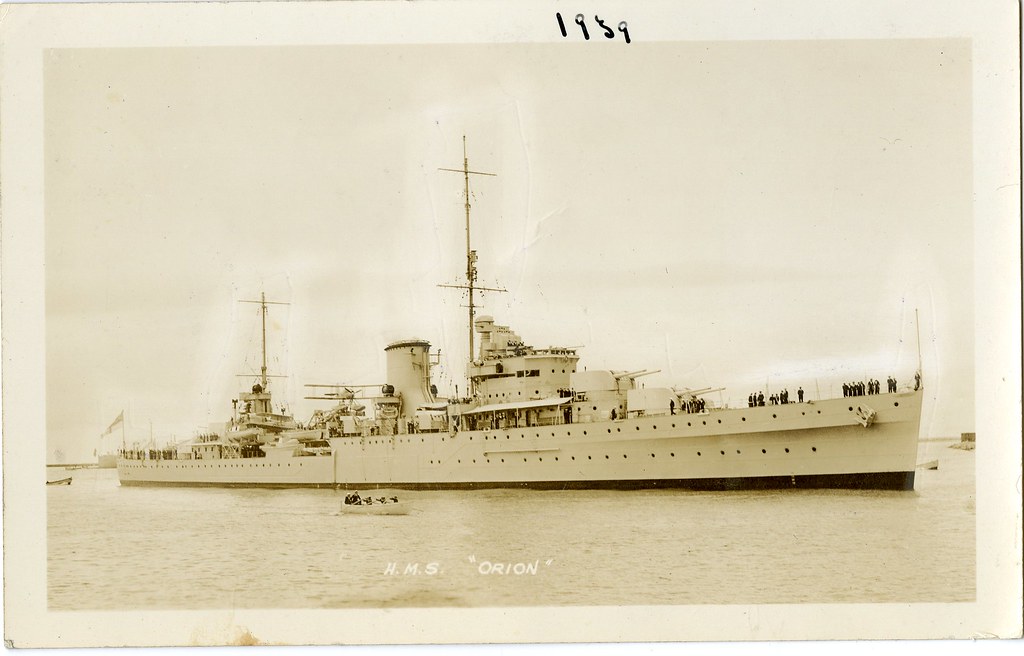
HMS Orion, c.1939 — the Leander-class light cruiser aboard which Warren began his wartime service.
The next convoy, from Londonderry towards Gibraltar, was very different. Two ships were lost before Orion could respond, and Warren remembered one damaged merchant ship continuing despite a huge hole amidships. The crew also picked up seven survivors from a German U-boat — an encounter that made a lasting impression on him.
“I remember being surprised they were human young chaps like the rest of us, after all the propaganda that was pumped into us.”
With the situation in the Mediterranean worsening and Malta under increasing pressure, Orion was sent for a quick refit at John Brown’s shipyard at Dalmuir in Scotland. She then sailed south, taking the long route around the Cape of Good Hope and through the Suez Canal. For Warren it was the beginning of a very different part of the war.
The voyage took them first to Freetown in Sierra Leone and then Cape Town, which Warren remembered particularly fondly for its hospitality. From there Orion continued via Aden and the Red Sea to Egypt, eventually reaching Alexandria — where, in Warren’s words, “all hell seemed to have let loose.”
“Then on to Cape Town, now that's a town, hospitality at it's best, free beers invites to homes, trips up to Table Mountain lights blazing everywhere - couldn't go wrong.”
From Alexandria, Orion joined the cruisers Penelope and Aurora, together with several destroyers and fast merchant ships, for a convoy towards Malta. Two days out the operation was abandoned as German aircraft inflicted heavy losses. Orion herself was hit by a bomb which penetrated the Forward Mess Deck.
HISTORICAL CONTEXT
The Battle of Cape Matapan
On 28 March 1941, HMS Orion fought at the Battle of Cape Matapan, one of the Royal Navy's most important victories in the Mediterranean. Orion served as flagship of the cruiser force alongside ships including HMS Ajax and HMAS Perth.The battle ended in a major defeat for the Italian fleet and helped strengthen British control of the eastern Mediterranean.
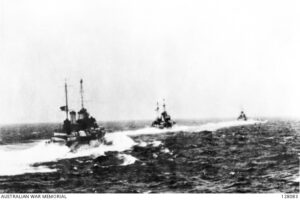
HMS Orion leads the line at the Battle of Cape Matapan, 28 March 1941, followed by HMS Ajax and HMAS Perth.
Photographed from HMS Gloucester. Australian War Memorial, Public Domain.
HMS PERTH, HMS AJAX AND HMS ORION AT THE BATTLE OF MATAPAN IN THE IONIAN SEA
Warren remembered the attacks by Ju 88s and Stukas, the rough seas and the loss of ships around them. Returning safely to Alexandria brought some relief, although there was little respite: Orion was soon back at sea and later saw further action around Crete.
“We lost a lot of ship we were hit with a bomb which went into the Forward Mess Deck right old mess.”
During the fighting around Crete, Warren lost a friend when the ship’s blacksmith was killed. Not long afterwards, Warren and several others from his mess became ill with dysentery, apparently caused by food taken aboard locally. Three of them were put ashore at Port Said and transferred to the hospital ship Maine, lying in the Bitter Lakes near the Suez Canal.
Warren remembered being seriously ill, but after recovering he was given a week’s leave in Cairo, where he visited the pyramids and other sights. He then returned to the naval base at Alexandria expecting to rejoin Orion, only to discover that she had already sailed — taking some of his kit with her.
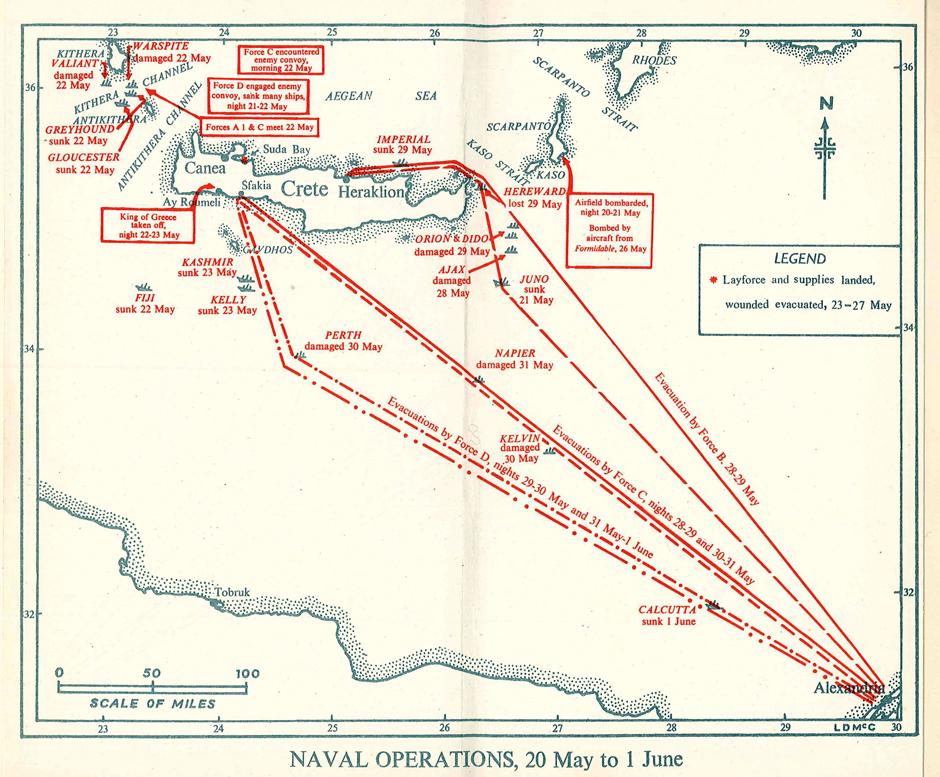
HISTORICAL CONTEXT
The evacuation of Crete — May 1941
On 28 May 1941 HMS Orion sailed from Alexandria as flagship of Force B to evacuate Allied troops from Heraklion. After embarking the troops overnight, the force came under sustained German air attack on its return.Orion was repeatedly hit. Bombs caused severe damage, casualties and loss of communications and steering; her captain, Geoffrey Back, was among those killed. Despite the damage, Orion survived and reached Alexandria on 29 May.
“From there it was to HMS Canopus which was based at Alexandria to pick up the Orion only to find she had sailed and taking some of my kit with her.”
After losing touch with Orion, Warren remained in Alexandria before being sent to Villa Lauris at Stanley Bay, headquarters of Admiral Harwood. There he worked as the Admiral’s personal shipwright, liaising with local contractors — a posting Warren remembered as something of a luxury after his experiences at sea.
“This was a real plumb job I never had it so good looking out over Stanley Bay Hong Kong swimming every morning amid all the bathing beauties.”
It did not last. With the battle of El Alamein under way, Warren volunteered for one of the naval parties being formed to follow the Eighth Army across North Africa. His unit, R Party — code-named “King Kong” — was intended to move into captured ports behind the advancing army and help get them working again so that supplies could be brought in.
The Western Desert
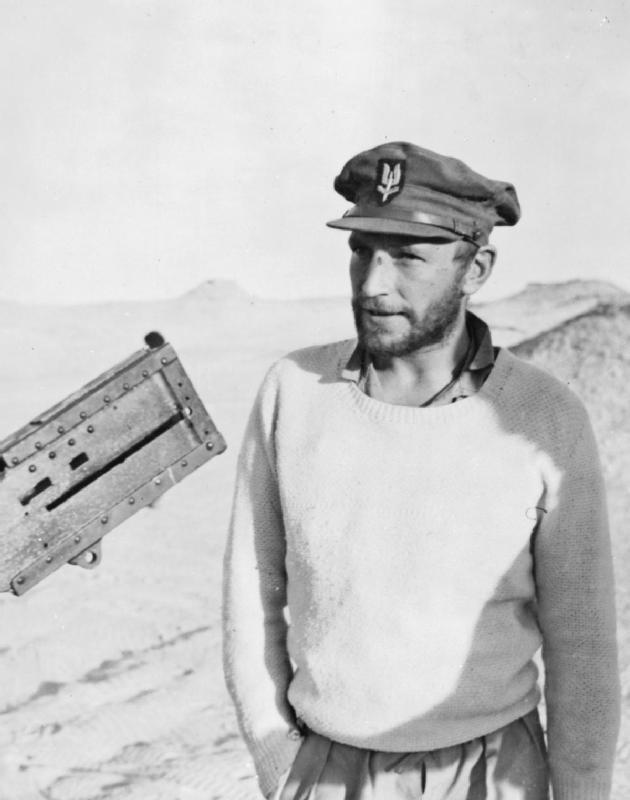
Warren’s new unit trained at Kabrit, a desert camp on the banks of the Suez Canal. With only a few shipwrights in the party there was plenty for him to do, including fitting plywood to the sides of fifteen trucks to make them resemble German half-tracks. Warren also remembered meeting Paddy Mayne, one of the leading figures in David Stirling's newly formed SAS, which was training at Kabrit alongside the Long Range Desert Group.
HISTORICAL CONTEXT
Kabrit and the birth of the SAS
When Warren trained at Kabrit, the desert camp was also home to David Stirling's newly formed Special Air Service. Established in 1941, the small unit trained there for raids behind Axis lines, initially using parachutes before increasingly working with the Long Range Desert Group.Warren remembered meeting Robert Blair “Paddy” Mayne at the camp. Mayne became one of the SAS's most celebrated wartime commanders, eventually taking command of 1 SAS after Stirling's capture in January 1943.
“I did meet Paddy Mayne Stirling 2nd in command who was a real toughie, never enough beer and was always around when our rum time came up.”
The naval party was issued with khaki battle dress and prepared to follow the army into the desert. Warren was given a short course on a machine gun and carried it faithfully for the next three months — although, characteristically, he remembered that nobody had actually given him any ammunition for it.
From Kabrit, Warren and the rest of the naval party moved west with their trucks, following the advance of the Eighth Army along the North African coast. Their task was practical rather than glamorous: to reach ports as they were captured, repair what they could and help restore the facilities needed to bring supplies forward.
The journey itself was an adventure. Their vehicles suffered repeated breakdowns and Warren remembered that, although the mechanics were experienced with marine engines, truck engines were another matter. At night he preferred to sling his hammock between two trucks rather than sleep on the desert ground, while burning petrol around the vehicles was supposed to discourage scorpions.
“I got pretty fit living in the desert - basic food and no booze.”
By the time Warren’s party reached Benghazi, the Eighth Army had already moved on and civilians were beginning to return. The naval party took over an Italian bank and the building next door while Italian prisoners of war were brought in to begin the dangerous work of clearing mines and booby traps left behind by the retreating forces.
Warren recalled how dangerous the work could be. A Nazi flag left flying on a nearby building proved to be booby-trapped, killing an Italian prisoner who had been sent to take it down — a stark reminder that the danger remained even after the fighting had moved on.
While at Benghazi, Warren briefly returned to sea aboard the Flower-class corvette HMS Gloxinia, where he spent about a week repairing one of her boats. The ship was sent in search of survivors from the minelayer HMS Welshman, although another vessel had reached them first.
HISTORICAL CONTEXT
HMS Gloxinia
HMS Gloxinia (K22) was a Flower-class corvette built for convoy escort and anti-submarine work during the Second World War. These small, hard-working ships served extensively in the Mediterranean as well as on the Atlantic convoy routes.While at Benghazi, Warren spent about a week aboard Gloxinia, repairing one of her boats. He remembered the corvette being sent in search of survivors from the fast minelayer HMS Welshman, which had been torpedoed and sunk off Libya.
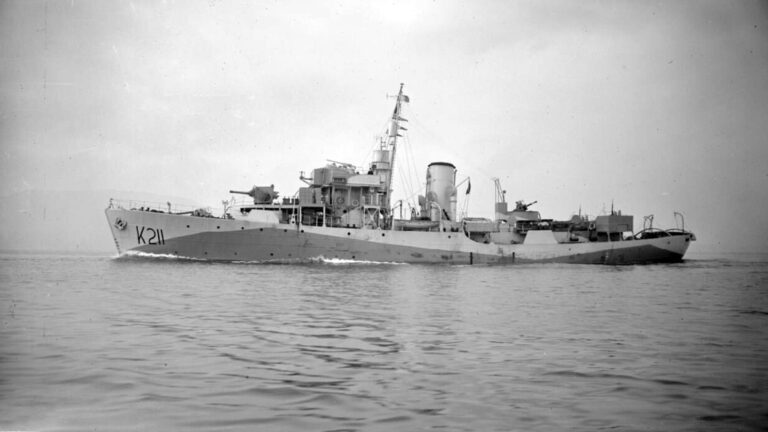
HMS Gloxinia (K22), Flower-class corvette
As the German forces continued their retreat, Warren’s party moved on from Benghazi, working their way through North Africa as the captured ports and towns returned to Allied control. He remembered travelling on to Bône and Sfax, while streams of German prisoners came in from the fighting further west. Supplies were becoming stretched as the advancing forces tried to cope with the numbers of prisoners.
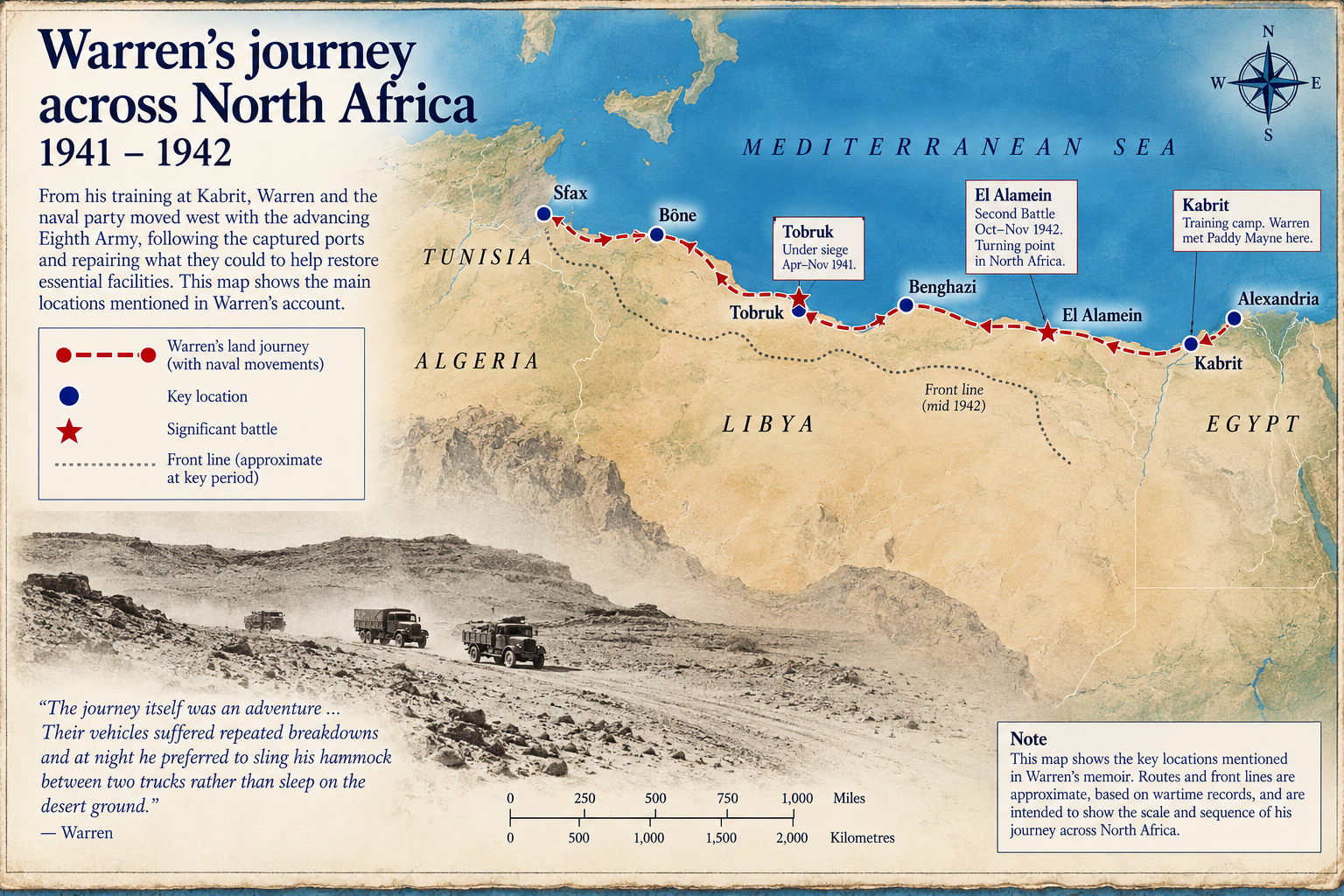
Eventually Warren and several others were ordered back to Alexandria. They travelled east with a convoy of trucks as far as Tobruk, before continuing by train through El Alamein to Alexandria. It was a long, hot journey, punctuated by breakdowns, but it brought Warren’s time with the naval party in the Western Desert to an end.
From diver to landing craft
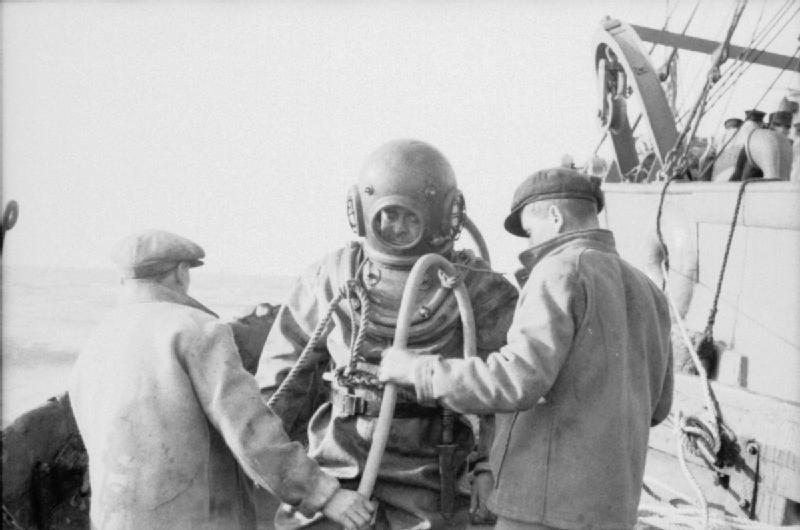
Back at HMS Canopus in Alexandria, Warren found himself sent on a diving course at HMS Mosquito, the Motor Torpedo Boat base in Alexandria Bay. The course brought together men from different ranks and branches of the Navy, some destined for service in midget submarines. Warren completed the training and qualified as a first-class diver.
HISTORICAL CONTEXT
Diving in the Royal Navy
Royal Navy divers worked on everything from underwater repairs and salvage to harbour clearance and bomb disposal. Training involved the traditional heavy canvas diving suit, weighted boots and copper helmet, with air supplied from the surface.Warren completed his training at HMS Mosquito in Alexandria Bay and qualified as a first-class diver — a qualification that almost took his naval career in a very different direction..
His new qualification almost took his naval career in a different direction. Warren was due to join a party clearing shipping from the Corinth Canal in Greece, but discovered that transferring to the diving branch would mean losing his Shipwright Trade Pay. Warren and three other shipwrights made their case to the senior officers and were allowed to remain in their existing branch, while still being available as divers in an emergency.
“So I made all the excuses I could find.”
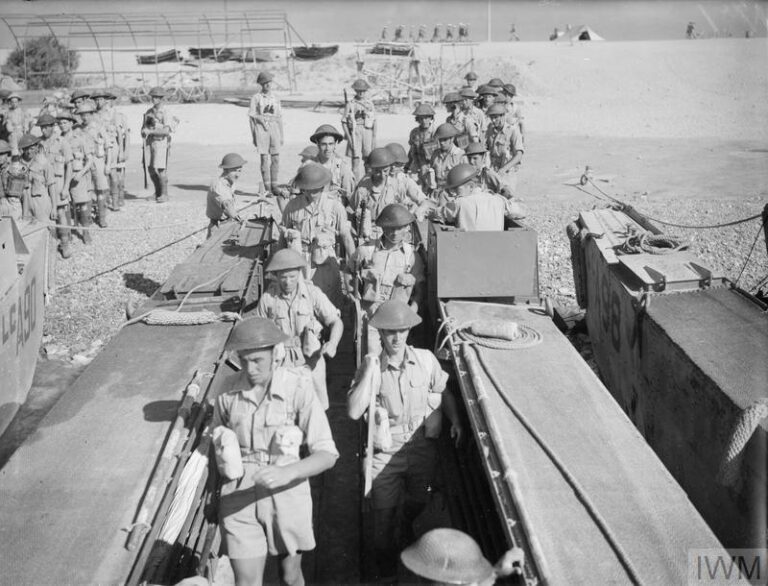
Warren was then sent to Navy House at Port Said and assigned to HMS Stag, where preparations were under way for the next stage of the Allied campaign. His work returned him to familiar territory: fitting out landing craft ready for the forthcoming landings in Sicily and Italy.
Royal Navy personnel training with landing craft at Kabrit, Egypt, June 1943. At Port Said, Warren was working as a shipwright preparing landing craft for the forthcoming Allied landings in Sicily and Italy.
HISTORICAL CONTEXT
Preparing for the invasion of Sicily
HMS Stag was not a ship but the Royal Navy's shore establishment serving the Suez Canal area, with bases and outposts stretching from Port Said along the Canal. In 1943 parts of this network were being used to prepare men and landing craft for Operation Husky, the Allied invasion of Sicily.Warren's work as a shipwright placed him behind the invasion force — fitting out and repairing the landing craft needed to carry troops and equipment ashore.
At HMS Stag, Warren’s responsibilities extended beyond preparing landing craft. He and the other shipwrights also looked after the destroyers HMS Croome and HMS Netherton, dealing with their minor repairs. As the senior shipwright, Warren found himself increasingly busy — enough to make him wonder whether avoiding the diving branch had been such a good idea after all.
“Being the senior shipwright, I was kept going [and] began to wish I'd stayed with the divers.”
The shipwrights also found themselves carrying out a much more sombre duty, making coffins for servicemen who died while passing through the Suez Canal area. Warren was angered by the difference between the basic coffins provided for ordinary ratings and those supplied for officers. The shipwrights protested, and eventually better coffins were provided for everyone.
By now Warren had spent three years in the Middle East and his time for returning home had arrived. After repeated delays he was finally sent to the HMS Sphinx transit camp outside Alexandria and from there boarded the troopship Duchess of Richmond for Liverpool.
After returning to Plymouth and beginning his Foreign Service Leave, Warren discovered that American servicemen were using the Plume of Feathers as their mess — bringing his wartime story, unexpectedly, right back to the place where his own story had begun.
Home from the war
After his leave, Warren returned to HMS Drake at Plymouth and was drafted first to the repair ship HMS Tyne, and then to HMS Colombo. The old cruiser was being used for trials in which new types of explosive shells were fired into Motor Torpedo Boats and Motor Launches to assess the damage they caused. Warren and the other shipwrights then had the unusual job of boarding the damaged craft and keeping them afloat so that they could be used again.
“Our job as shipwrights was to hop aboard and stop them from sinking so they could try and have another go.”
With the war coming to an end, Warren had to decide whether to leave the Navy or remain and make it his career. He chose to stay, initially signing on to complete twelve years’ service. He later recalled struggling with the examinations needed to advance to a higher rate, but with help from some of his dockyard-trained friends he passed.
His next draft was HMS Northway, an American-built Landing Ship Dock operated by the Royal Navy under Lend-Lease. The ship could partially submerge to allow landing craft to float into her dock and could carry tanks and other landing craft. For Warren, accustomed to hammocks and crowded mess decks, the American accommodation — with only two men to a cabin — was something of a novelty.
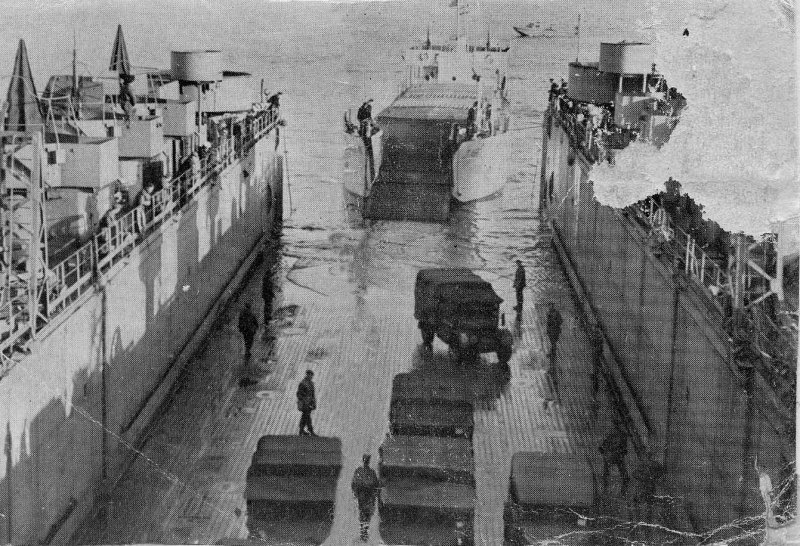
HMS Northway (F142), the American-built Landing Ship Dock aboard which Warren served after the war.
HISTORICAL CONTEXT
HMS Northway
HMS Northway was an American-built Landing Ship Dock transferred to the Royal Navy under Lend-Lease in 1944. Her vast floodable well deck allowed landing craft and amphibious vehicles to be carried inside the ship and floated directly into the sea.Before Warren joined her, Northway had taken part in the Normandy landings, delivering amphibious vehicles to Juno Beach and later supporting work on the Mulberry harbour. After the war, Warren travelled aboard her collecting redundant landing craft around Britain and later sailed with her to Germany.
HMS Northway’s first task was to travel around the British Isles collecting landing craft that were no longer required and taking them to Rosneath in Scotland. The work gave Warren the opportunity to see many parts of the British coastline before the ship was sent across the Channel to Germany.
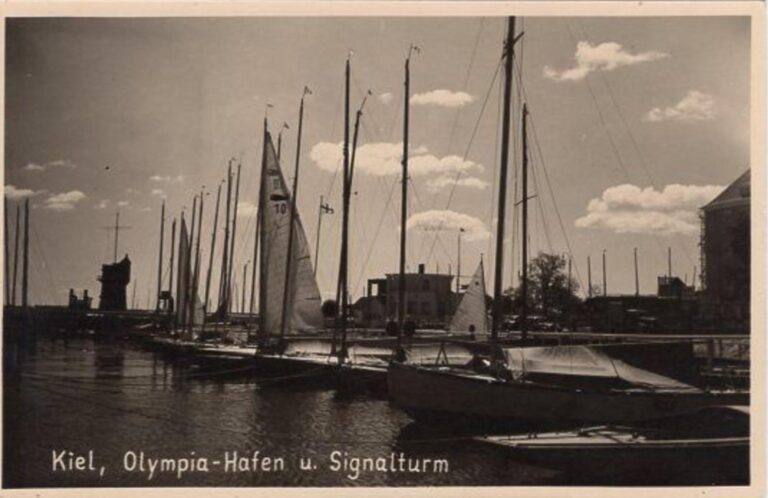
In Hamburg, Warren and the crew recovered four nine-and-a-half-ton yachts from the rubble, which he remembered as having been built for the 1938 Olympics. Their fixed keels made them awkward cargo aboard Northway. The ship also collected two enormous propeller shafts intended for the German tanker Altmark.
HISTORICAL CONTEXT
The Olympic yachts
Warren remembered recovering four nine-and-a-half-ton yachts from the ruins of Hamburg, which he believed had been built for the 1938 Olympics. The Olympic Games were not held in 1938; Germany had hosted them two years earlier, in 1936, with the sailing events based at Kiel.After the war British forces found the former Olympic yacht harbour at Kiel still filled with yachts, several of which were requisitioned for service sailing. Whether Warren's four yachts were themselves Olympic boats has not yet been established.
Further voyages took Warren up the River Scheldt to Antwerp and later to Cuxhaven and Bremerhaven. There he saw the German cruiser Prinz Eugen, which particularly caught his attention when he discovered the pin-ups displayed in her wardroom.
Explore the Prinz Eugen →
Back home, Warren became engaged to his childhood sweetheart Vera. She had served in the ATS during the war and, as Warren put it, understood service life and knew what she was taking on by marrying a man who had chosen to remain in the Royal Navy.
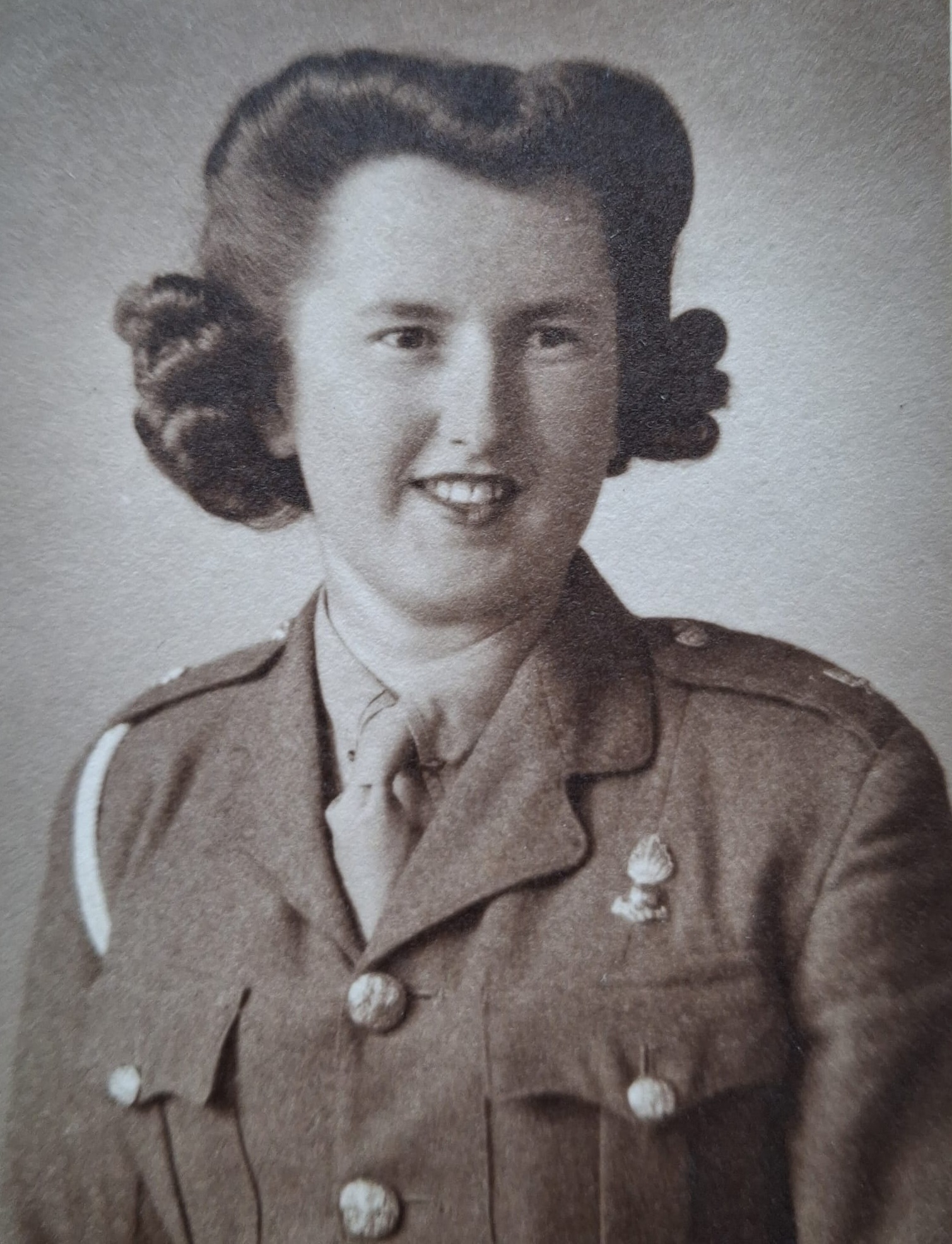
Vera Davis, Warren's childhood sweetheart, who served in the ATS during the war.
A life in the Royal Navy
HMS Northway’s time with the Royal Navy was coming to an end. As a Lend-Lease ship she was due to be returned to the United States, and Warren sailed from Plymouth aboard her in company with the aircraft carrier HMS Atheling, bound for Norfolk, Virginia.
Before entering the yard, the crew were ordered to throw their remaining stores overboard, including bedding and tools — something that particularly upset Warren when it came to his stock of timber and plywood. There was, however, one item the sailors were determined not to waste: the remaining rum ration.
“When it came to the surplus Rum Ration no way each mess got a cask, and it wasn’t abused.”
Once Northway had been handed back to the Americans, Warren and the crew were to return to Britain aboard the aircraft carrier HMS Indefatigable. Before they left, the Americans laid on some entertainment for the British sailors — and Warren remembered the spectacle of Roy Rogers appearing on the carrier’s aircraft lift, sitting astride his famous horse, Trigger.
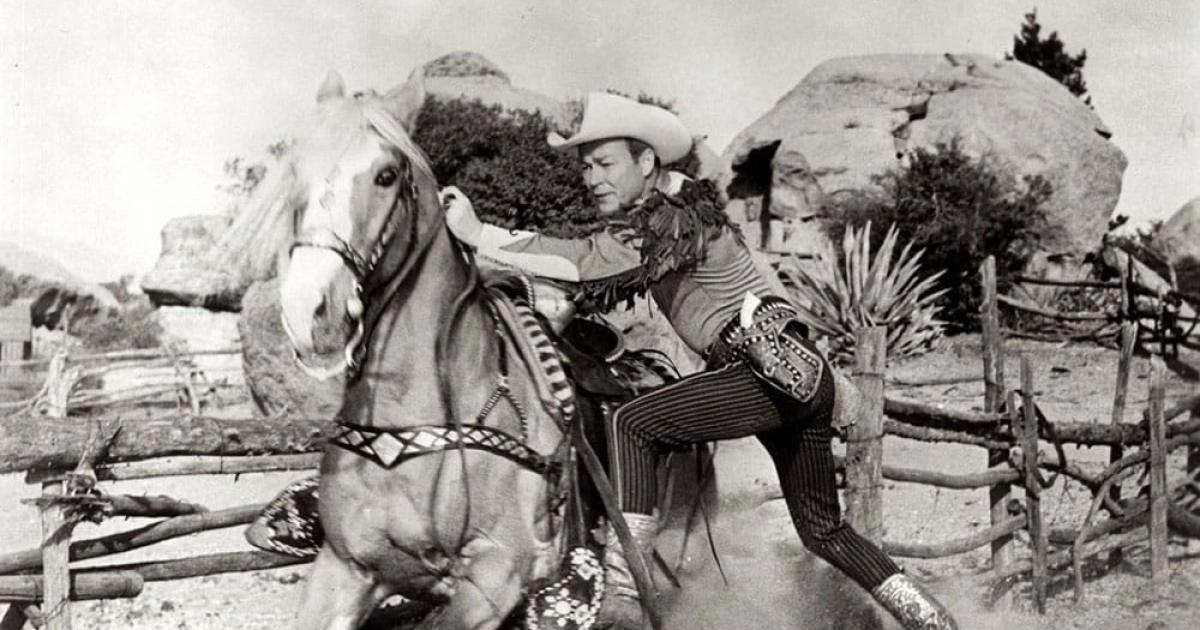
HISTORICAL CONTEXT
Roy Rogers and Trigger — at sea
Warren remembered an unusual piece of entertainment while HMS Indefatigable was preparing to return the British sailors home: Hollywood cowboy Roy Rogers appearing on the carrier's flight deck with his famous palomino, Trigger.Rogers and Trigger were enormous stars by this time. In 1946 they appeared together in My Pal Trigger, with Trigger famously promoted as “The Smartest Horse in the Movies.”
The reaction from the sailors was perhaps not quite what the organisers had intended. Warren recalled that the “Matelots” found Roy Rogers rather tame, although he was more impressed by the actor John Garfield and the blues singer Nellie Lutcher, who also performed.
“I am afraid the Matelots found him a bit of a sissy.”
HMS Indefatigable brought the crews back to Portsmouth, after which Warren returned to Plymouth and another period of home leave. His Royal Navy career, however, was far from over.
After his leave Warren was drafted to HMS Alaunia, a converted liner being used as a repair ship in Devonport. He was given responsibility for the ship’s boats and worked from a well-equipped workshop on the boat deck. Better still, the posting meant that he could get home to Portscatho most weekends.
Vera and family
On 19 April 1947, Warren married his childhood sweetheart Vera at Gerrans Church. Doug Chaffin was his best man, although Warren admitted that the two of them nearly got themselves into trouble by having a couple of Navy tots while waiting for the car to take them to the church. His father was not impressed — but, as Warren later observed, the photographs proved that everything turned out all right.
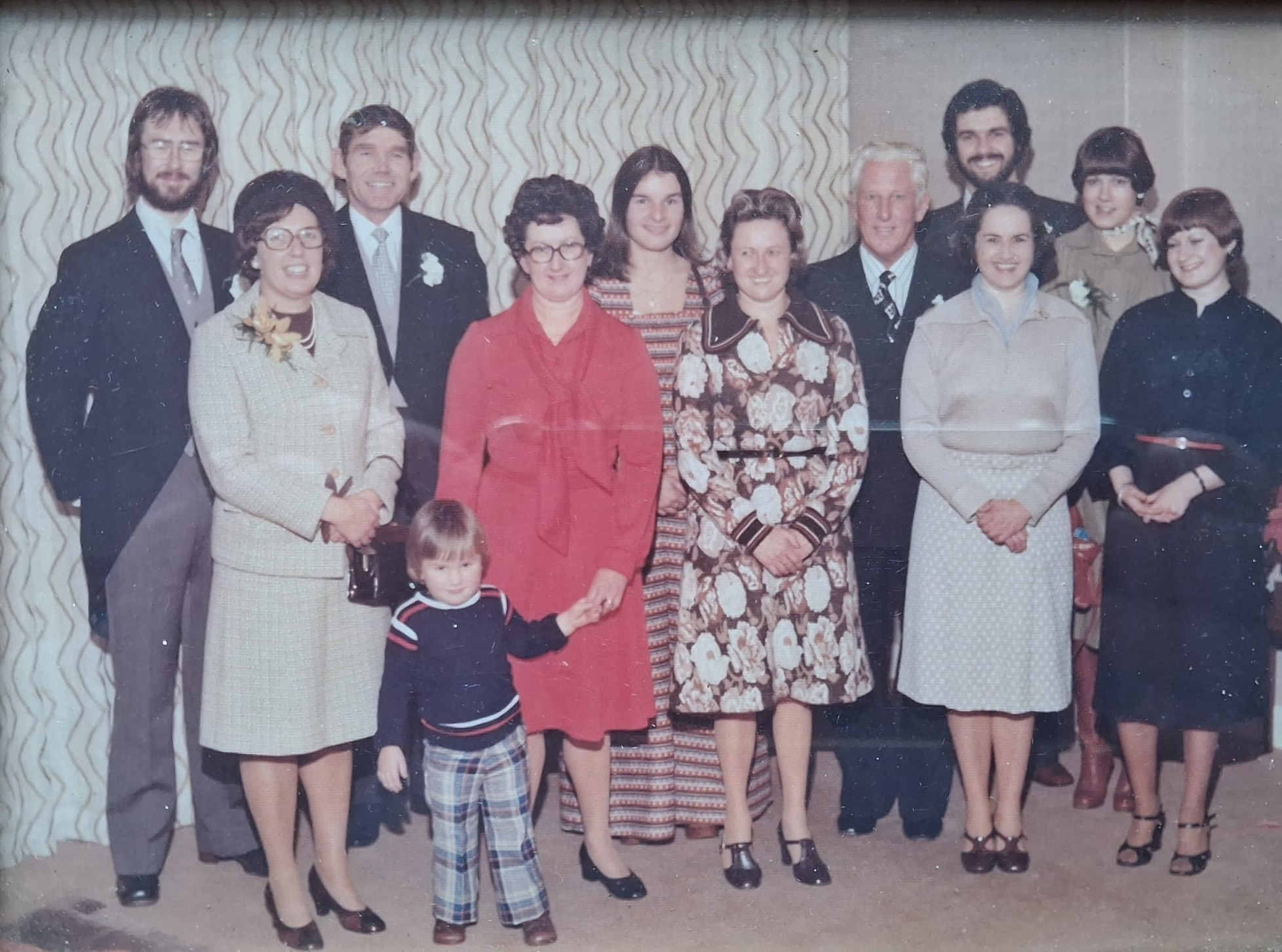
“My father was very furious, anyway the photos prove it went ok.”
On 2 February 1948 their son, John Edwards Peters, was born, weighing six and a half pounds. Fortunately it was a weekend and Warren was home for the birth, which he remembered simply as “quite an event in our lives.”
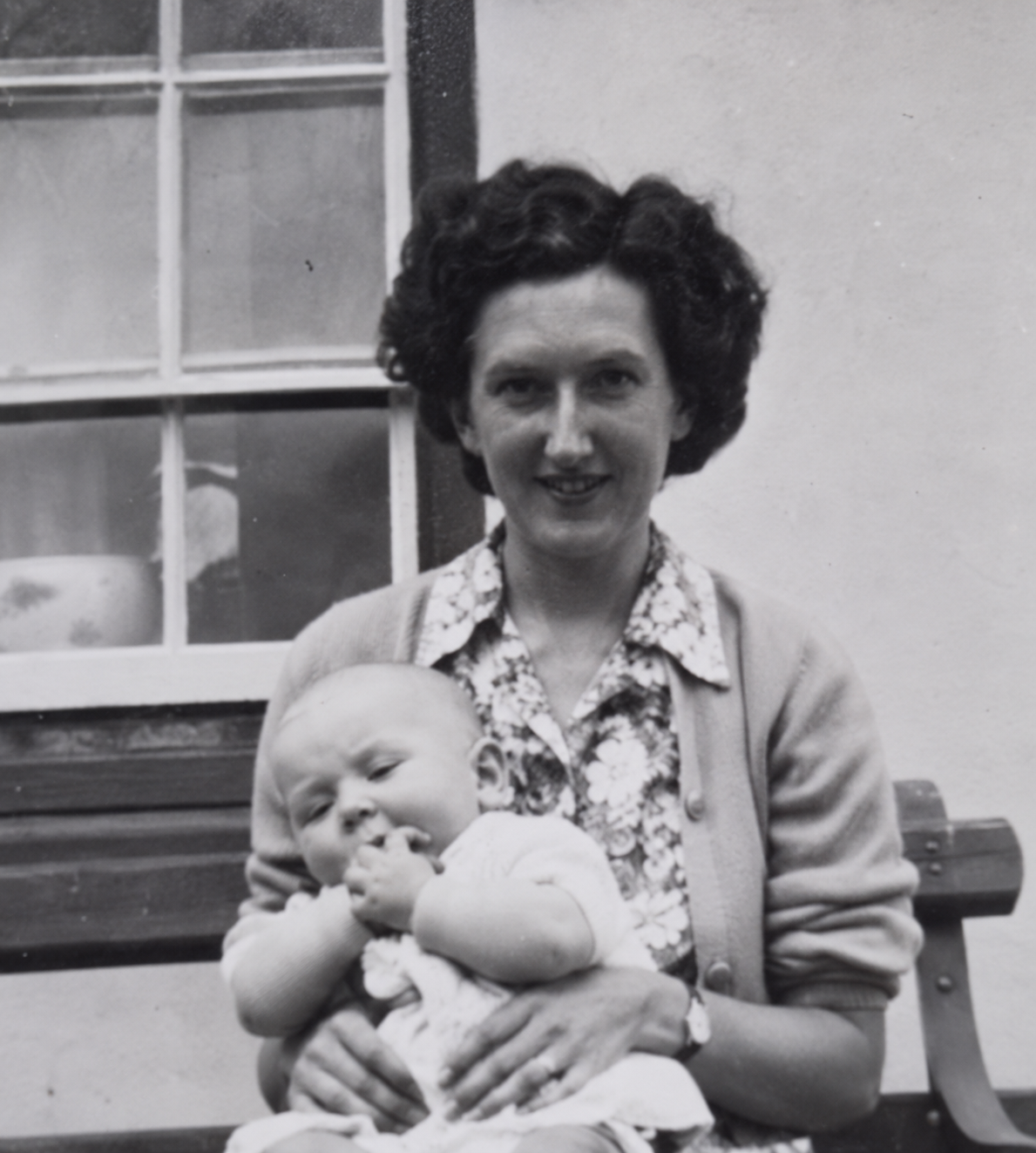
Vera with their son John Edwards Peters, born 2 February 1948
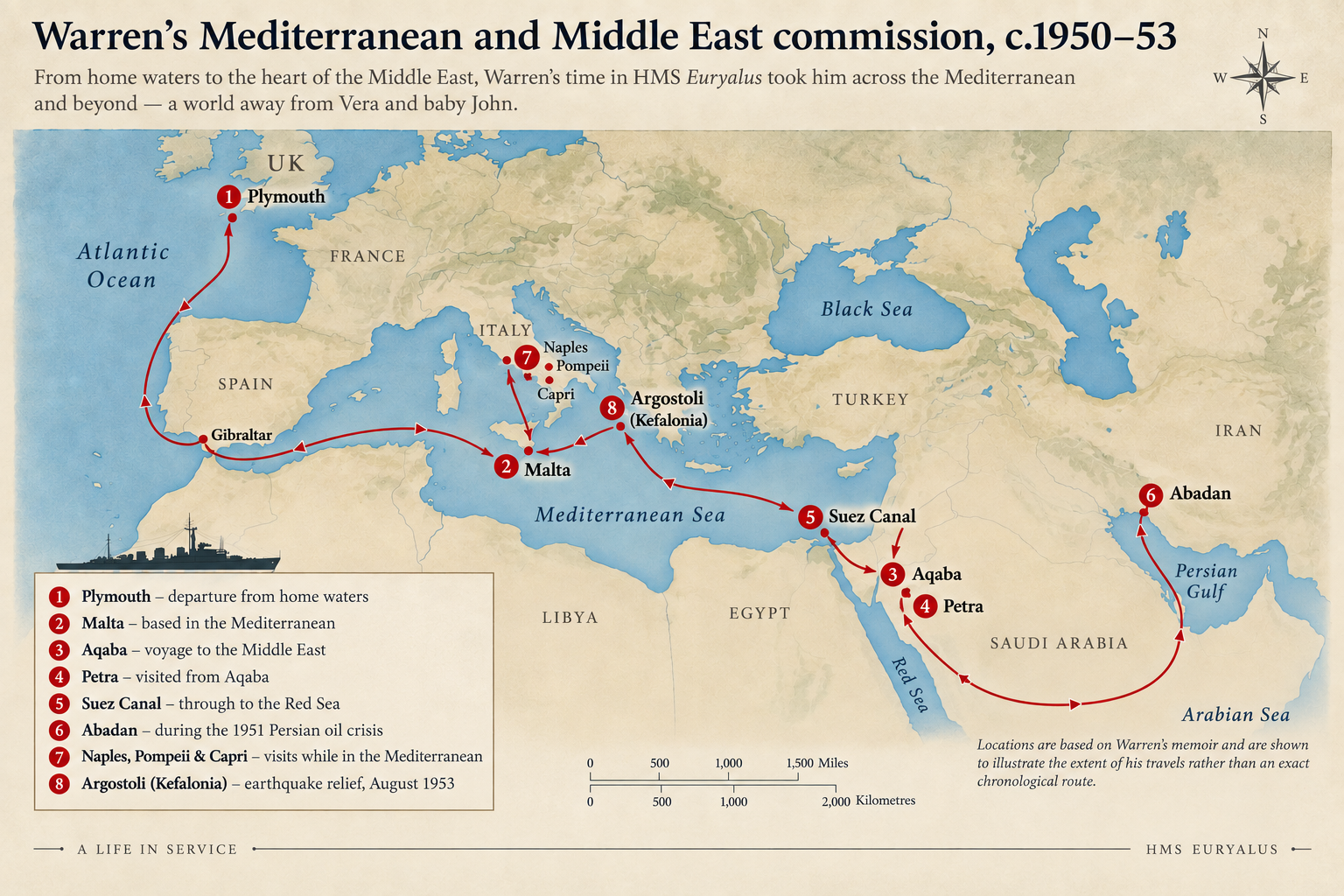
Warren’s time aboard HMS Alaunia could not last forever. His next sea-going draft was HMS Euryalus, a Dido-class cruiser bound for a two-and-a-half-year commission in the Mediterranean. For Warren, the timing was difficult. John was still very young and beginning to become, as Warren put it, “interesting”, but service life meant leaving Vera and their son behind once again.
“Two and a half years seemed to be a hell of a long way just as John was getting interesting and needs a dad, as the saying goes, you shouldn't have joined.”
Euryalus sailed first for Malta, which was intended to be her main base. There was some hope that Vera and John might eventually be able to join Warren there, as a few families did, but the ship spent far less time in Malta than expected. Trouble in the Persian Gulf soon took her east through the Suez Canal and Red Sea towards Abadan.
HISTORICAL CONTEXT
HMS Euryalus
HMS Euryalus was a Dido-class cruiser which had seen extensive wartime service in the Mediterranean and Pacific. After the war she returned to the Mediterranean Fleet, operating from Malta.Warren's commission eventually took him far beyond the Mediterranean. In 1951 Euryalus was sent to the Persian Gulf during the Abadan crisis, spending weeks anchored off the Iranian oil port in intense summer heat.
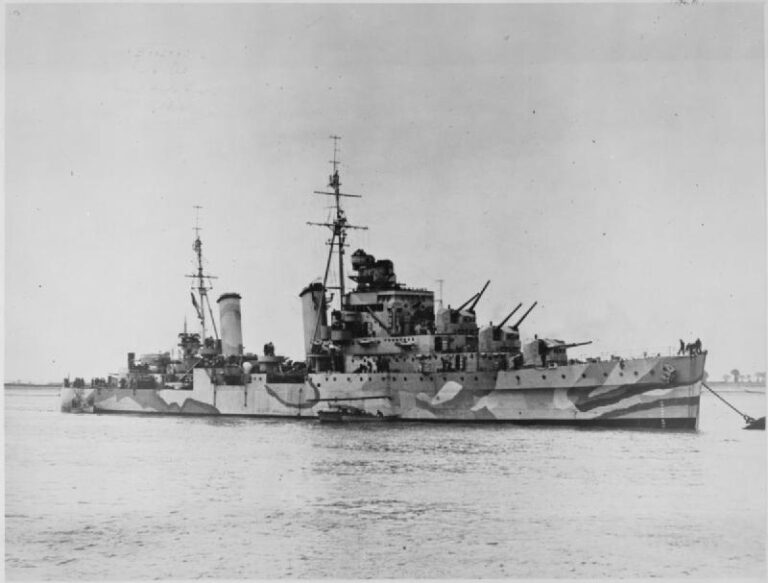
HMS Euryalus (42), Dido-class light cruiser, June 1941.
Royal Navy official photograph / Imperial War Museums. Public Domain.
The commission took Warren to places he had never expected to see. At Aqaba he was chosen for a visit to Petra, travelling much of the way by lorry and then continuing on horseback and mule. He remembered the discomfort almost as clearly as the ancient city itself.
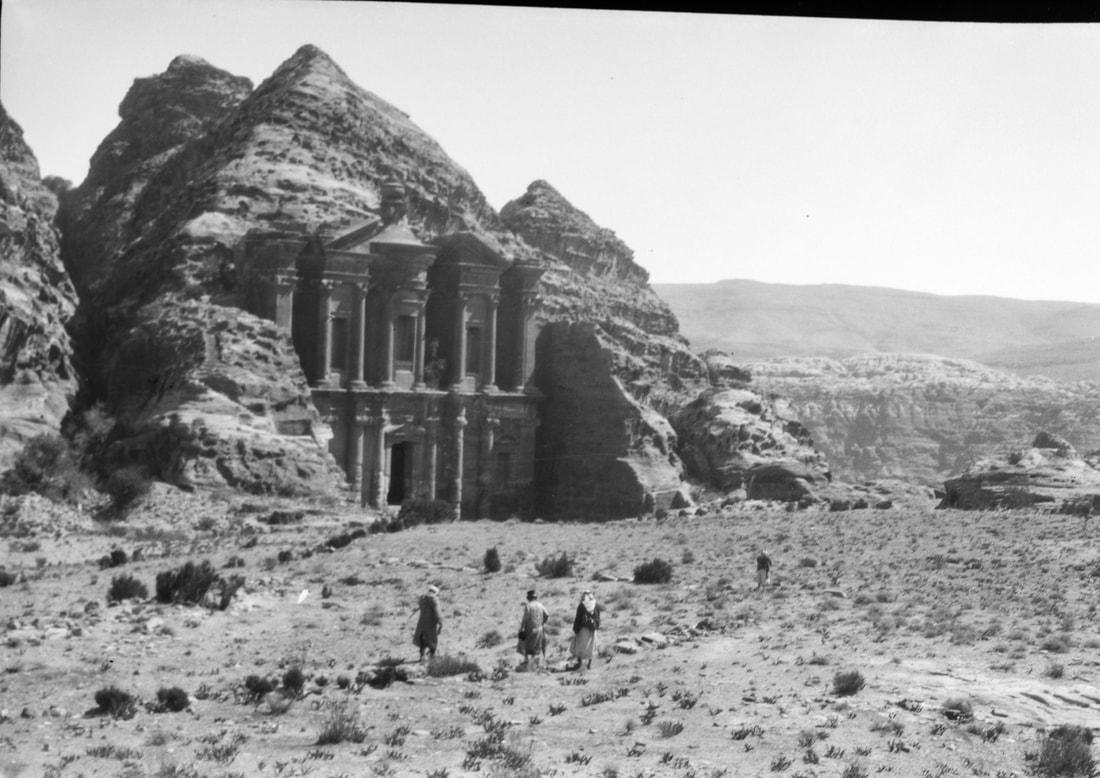
Petra, Jordan, c.1940–46.
Matson Photo Service / Library of Congress. No known restrictions on publication.
HISTORICAL CONTEXT
Journey to Petra
While Euryalus was in the Middle East, Warren joined a trip from Aqaba to the ancient city of Petra. The final part of the journey was made on horseback — much as visitors had reached the remote site for generations.These photographs of Petra were taken by the Matson Photo Service during the 1940s, close to the period in which Warren made his visit.
At Abadan, Euryalus relieved HMS Gambia and anchored opposite the oil refinery. Warren remembered the oppressive heat and humidity and a tense atmosphere, with guns on the Iranian side trained towards them. It was another reminder that although the Second World War was over, naval service could still take him into uncertain situations far from home.
Explore the Persian oil dispute →
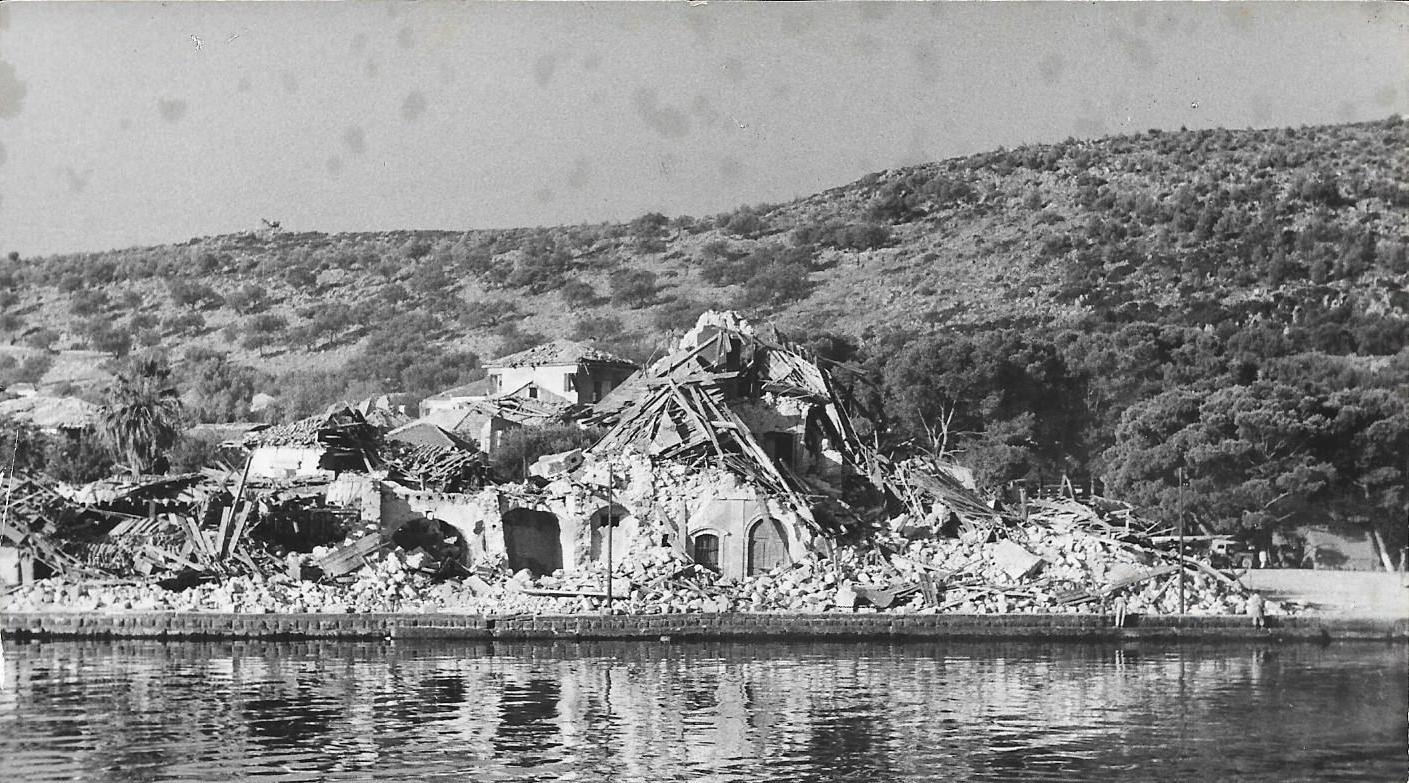
Later the ship returned to the Mediterranean, where Warren’s experiences ranged from exercises around Cyprus to a mercy mission following an earthquake at Argostoli in Greece. Euryalus carried tents and food to the affected area, and Warren helped move supplies into villages in the hills. While they were there another earth tremor struck, an experience he never forgot.
Petra, Jordan, c.1940–46.
Matson Photo Service / Library of Congress. No known restrictions on publication.
HISTORICAL CONTEXT
THE IONIAN EARTHQUAKE
In August 1953 a series of powerful earthquakes devastated the Ionian Islands of Kefalonia, Zakynthos and Ithaca. Argostoli was largely destroyed, leaving thousands homeless and prompting a major international naval relief operation.Warren remembered Euryalus entering Argostoli to provide assistance and experiencing a violent aftershock while anchored there. Contemporary accounts confirm that severe aftershocks continued during the relief operation, with eyewitnesses describing landslides and extraordinary disturbance around the harbour.
“The sea was boiling all around the ship. It was very frightening the tremendous power of Mother Nature.”
There were lighter moments too. During the Mediterranean Fleet Regatta, Euryalus’s shipwrights entered a whaler crew and beat the boat from HMS Glasgow. Warren’s reward for the mile-and-a-half race was a bottle of beer and a handshake from Lord Mountbatten. Back in Malta he also spent a week aboard the submarine HMS Totem — an experience which left him smelling of diesel oil for days.
See Mountbatten taking command of the Mediterranean Fleet →
A visit to Naples brought trips to Pompeii and Capri, and Gracie Fields came aboard to sing for the crew. But after two and a half years away, the sight Warren really wanted was home. HMS Cleopatra eventually arrived in Malta as their relief, and Euryalus began the long journey back to Britain.
When Euryalus finally arrived at Plymouth, her paying-off pennant was flying and a band was playing on the jetty. Waiting there were Vera and John, together with Vera’s family and Warren’s father. After two and a half years away, Warren was struck by how much his son had changed.
“John quite a different boy - 2 and a half years older.”
A career at sea
After returning from Euryalus, Warren was able to enjoy something closer to family life. He and Vera had been allocated a newly built three-bedroom council house, and his next posting to RNAS St Merryn came with married quarters at Padstow. Warren knew the area well from his boatbuilding apprenticeship, John started school there, and for two years the family were able to live together while Warren continued his naval career.
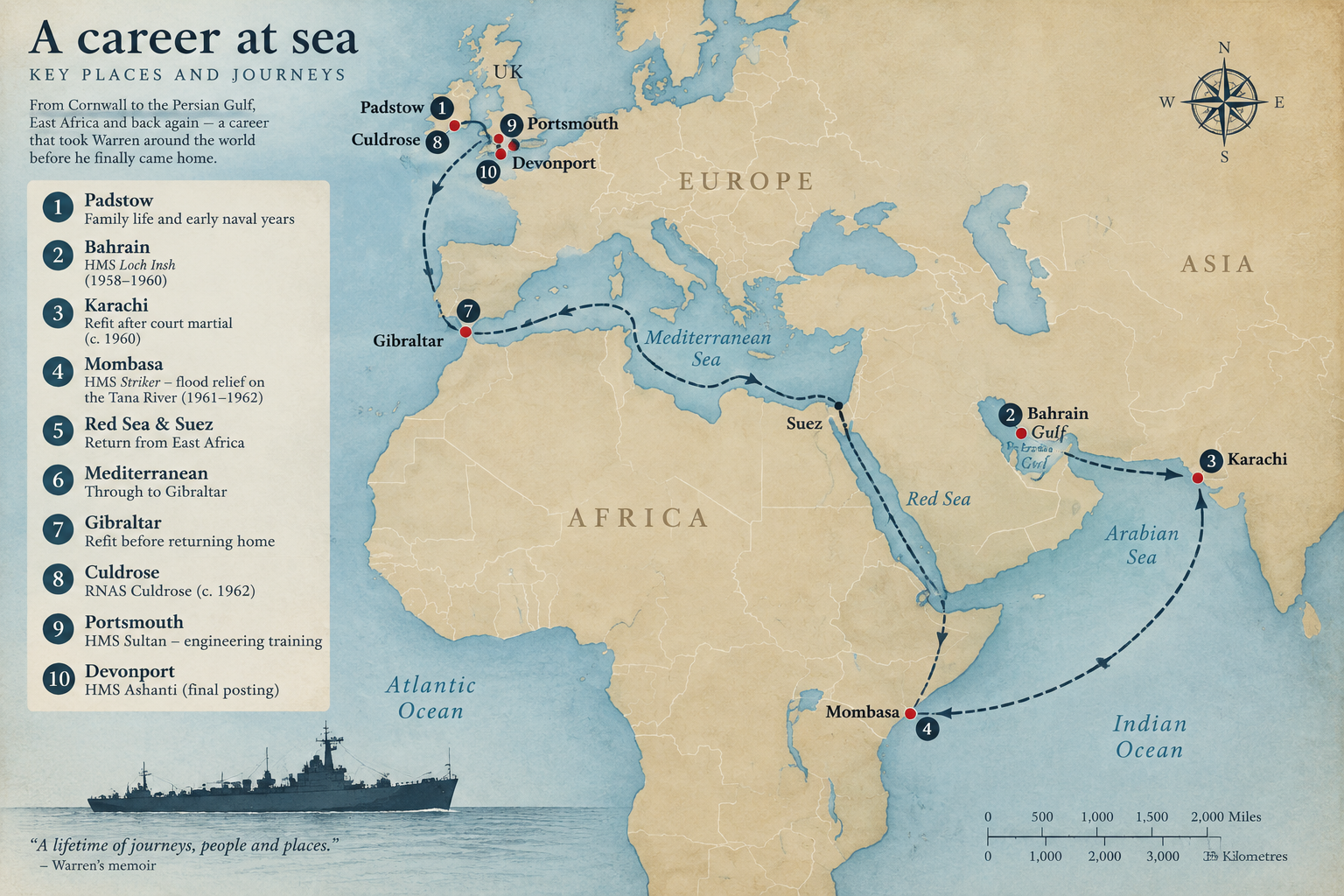
Warren had now completed twelve years in the Navy, but decided to sign on again to complete twenty-two years and qualify for a pension. Inevitably, another sea-going draft followed. His former commanding officer, Lieutenant Commander Ian Shaw, asked him to join the Loch-class frigate HMS Loch Insh as her only shipwright. The ship was bound for a twelve-month deployment east of Suez, much of it in the Persian Gulf.
Soon after reaching Bahrain, Loch Insh was sent to assist the Norwegian tanker Hawkong, which had broken down carrying a cargo of high-octane fuel. The frigate towed the much larger tanker for four days back to Bahrain, leaving everyone aboard dreaming of the salvage money they might receive.
“Everyone looking for huge amounts of salvage money. Several years hence I got £16.”
The deployment was not without incident. On 26 August 1960, Loch Insh ran aground on a sandbank while leaving Bahrain. Ammunition and fuel were removed to lighten the ship before two tugs eventually pulled her free without damage. Warren subsequently found himself involved in the aftermath when Captain Ian Shaw and the ship’s navigator faced a court martial and were reprimanded.
After another spell in Plymouth, Warren secured a posting to RNAS Culdrose. It was a welcome change: he could drive home every night and enjoy family life while still serving in the Navy. But another overseas posting eventually followed, this time aboard the Landing Ship Tank HMS Striker, supporting a detachment of Royal Marines in the Persian Gulf. Warren’s job was to maintain their eight landing craft.
“I think the Admiralty was trying to kill me off with the Persian Gulf Climate and my pension not far off.”
HMS Striker took Warren back towards the Persian Gulf, this time working alongside Royal Marines and maintaining their landing craft. The ship herself was in poor condition and later required a refit at Karachi, after which Striker continued via Bombay before eventually turning west again.
On the way home, Striker was diverted to Mombasa, where severe flooding had cut off villages inland. Warren and others were sent up the River Tana in landing craft loaded with maize and relief supplies. The river was in full flood, with snakes, crocodiles and mosquitoes everywhere, and the crews often had to improvise as they moved between isolated communities.
Warren remembered collecting people trapped by the floods, including two women who gave birth during the operation. One of the babies, a boy, was named after the ship. The relief mission took them as far inland as Garissa, and Warren’s recollections mix the seriousness of the work with the same dry humour that runs through much of his memoir.
HISTORICAL CONTEXT
Flood relief in Kenya
In late 1961 severe flooding in Kenya cut off communities along the Tana River. HMS Striker was diverted to Mombasa and her landing craft were used to carry maize and other relief supplies inland, while sailors and Royal Marines helped rescue people left homeless by the floods.Warren's memories closely match those of other Striker crewmen, who recalled working along the Tana River delivering food to flooded villages and evacuating stranded families. The ship and her landing craft were later officially commended by the Government of Kenya for their part in the relief operation.
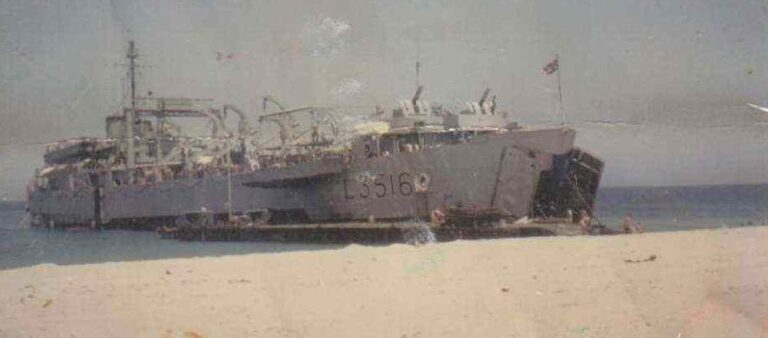
HMS Striker (L3516), the Landing Ship Tank aboard which Warren served during the 1961 Kenya flood-relief operation.
“One morning I wound up the ramp and there was a 10 foot Anaconda curled up under it.”
After the African relief work, Striker returned through the Red Sea and Mediterranean before entering refit at Gibraltar. Warren was eventually flown home and later secured another posting to Culdrose, this time looking after the station’s recreational boats at Falmouth. It was the sort of posting he valued most: close to home, practical work, and the chance to be with Vera and John each evening.
By now Warren was approaching the point where his twenty-two years of service would qualify him for a pension. Even so, with Vera’s agreement, he decided to extend his naval career for a further five years.
Warren’s final years in the Navy brought changes he did not particularly welcome. The shipwright branch was being absorbed into engineering, taking him away from the woodworking and practical skills around which much of his career had been built. He was sent to HMS Sultan at Portsmouth for engineering training before joining HMS Ashanti at Devonport.
“grease and sawdust doesn't mix.”
After working up around Portland, Warren discovered that Ashanti was to be sent to the Persian Gulf. He had joined expecting a West Indies cruise, and another deployment to the Gulf held little attraction after so many years spent away from home. Having already completed three years of his additional service, Warren realised that he could leave the Navy by giving a few months’ notice.
He decided it was time to go — a decision which, Warren recalled, came as “much relief to Vera.” After a naval career that had begun during the Second World War and taken him across the Atlantic, Mediterranean, Middle East, Africa and Indian Ocean, Warren was finally coming home for good.
Back to Portscatho
Civilian life was, as Warren put it, “a different world”. After so many years in the Royal Navy, he began working with Gerry Frayne installing warm-air central heating in new bungalows at Truro. The work was surprisingly familiar — assembling ducting was not so different from some of the practical work he had known aboard ship.
“Civvy street a different world.”
When the heating work came to an end, Warren moved into the television business, first with Gerry and later with Paul Holt. He continued doing television work until he was 65, when climbing around on roofs was becoming, in his words, a little difficult for someone “getting a bit long in the tooth”.
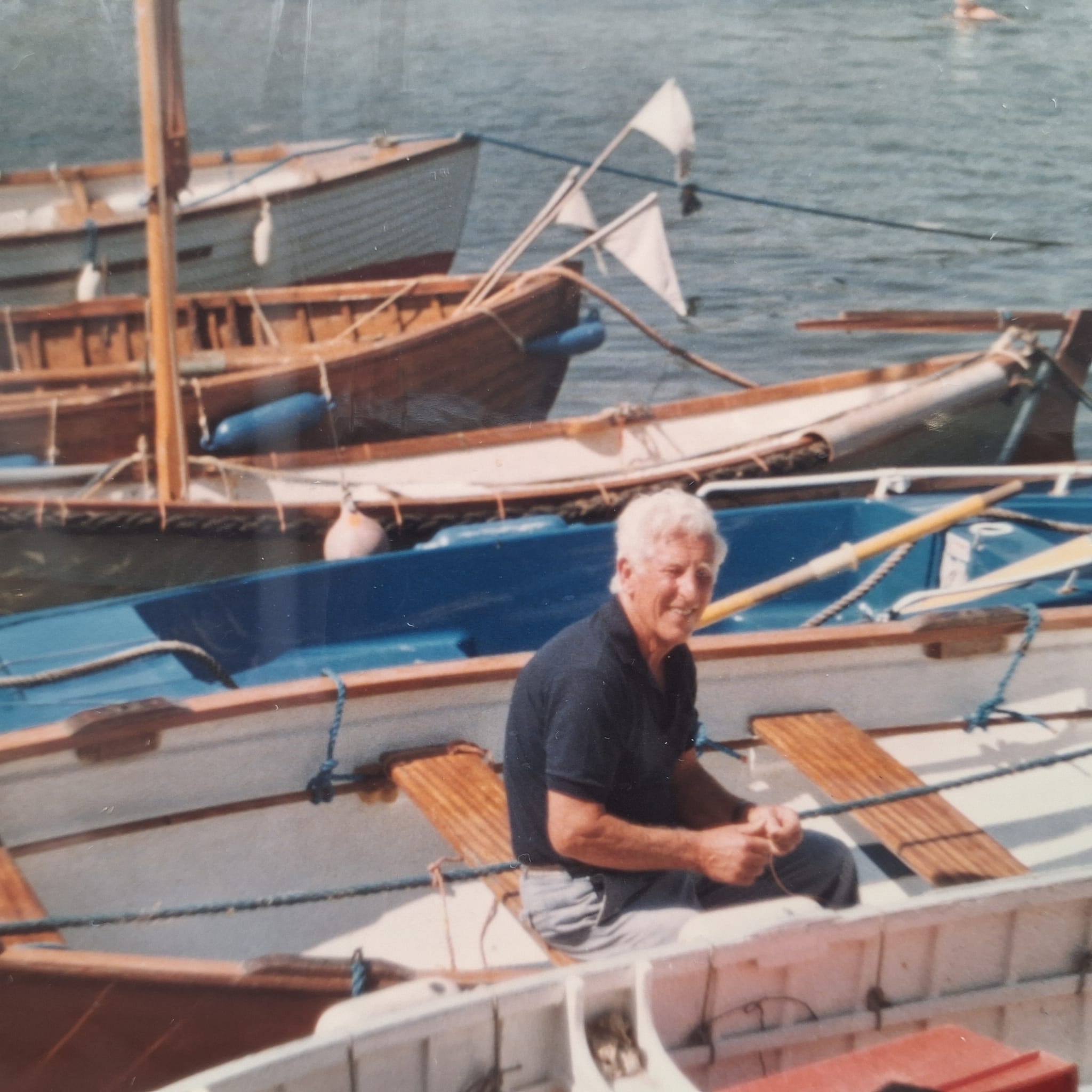
Retirement did not mean Warren stopped being busy. He served on the Parish Council for thirteen years and particularly enjoyed those occasions when he felt he had been able to achieve something for the community. It was another connection with the area in which his story had begun more than sixty years earlier.
Family remained central to Warren and Vera’s life. Their son John married and settled in Falmouth, where he became a director of the boatbuilding company Cygnus Marine. John and his wife Camilla had three sons and a daughter, and Warren made no attempt to disguise the pleasure that their grandchildren brought them.
“The grandchildren give Vera and I great pleasure we do our best to spoil them.”
Warren and Vera had known each other since childhood in Portscatho. Vera, born at Trewithan on 23 July 1922, had served during the war in the Auxiliary Territorial Service, working on anti-aircraft gun sites plotting German aircraft. They married in 1947, and Warren recognised that life as a service family had often placed as much responsibility on Vera as it had on him.
Looking back on their marriage, Warren remembered the long separations and the decisions Vera had been left to make while he was away. Yet through the war, his long naval career and everything that followed, their relationship stretched from childhood in Portscatho into old age together.
“We were childhood sweethearts, so they tell me.”
On 19 April 1997, exactly fifty years after their wedding at Gerrans Church, Warren and Vera celebrated their Golden Wedding. More than eighty family and friends gathered at the Memorial Hall. Warren had recently undergone an operation and was not feeling his best, but the anniversary marked an extraordinary half-century together.
Warren and Vera’s later years remained full of family, friends and the occasional adventure. Their Golden Wedding was followed by a trip to Norway to see the fjords and the North Cape, and an unexpected invitation to Buckingham Palace after their names were drawn from hundreds of Cornish couples celebrating fifty years of marriage.
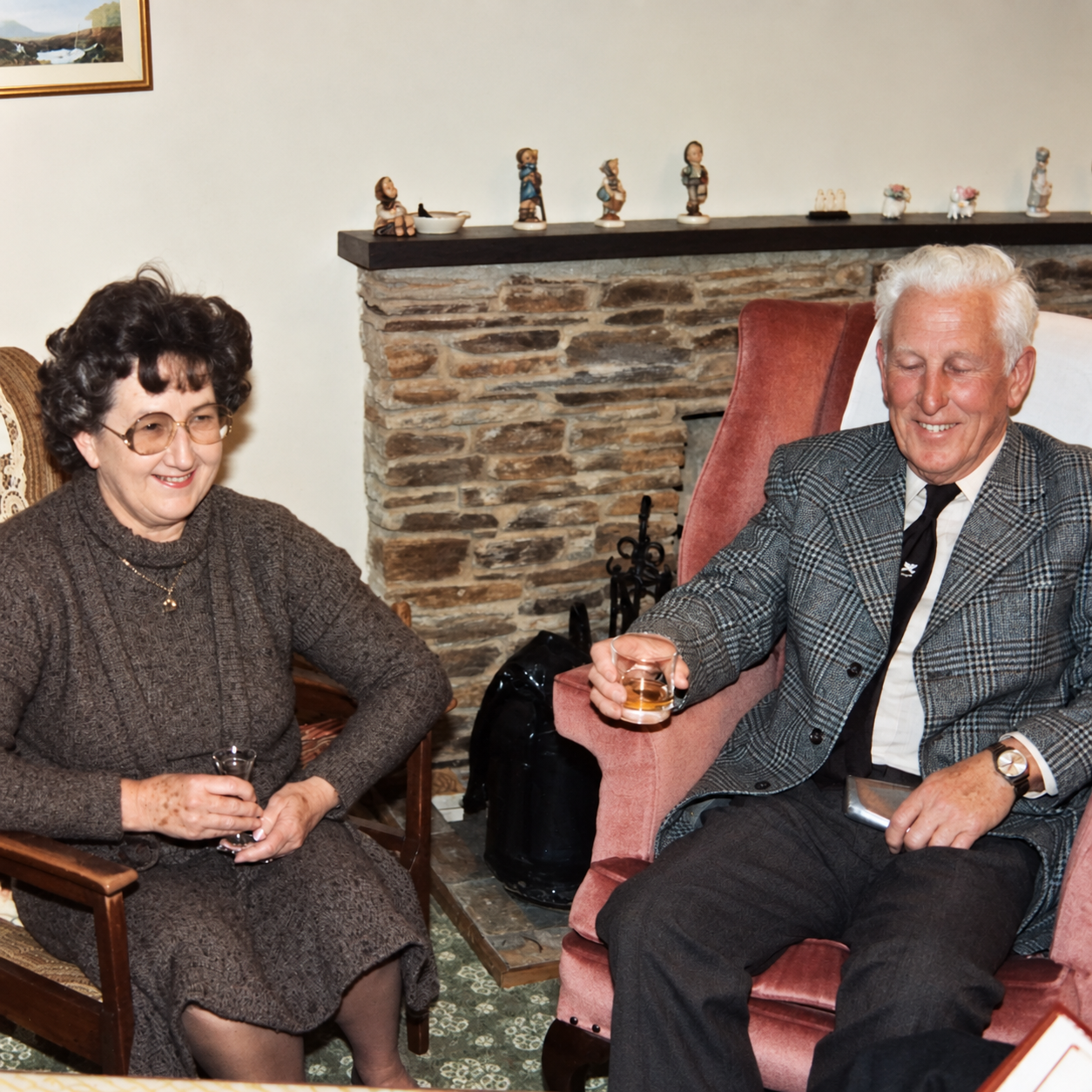
“Us getting married in April 1947 we had a good life together, hard at times especially for Vera being a service wife and to make the most of the decisions when we were separated.”
By then Warren had travelled an extraordinary distance from the boy born above the Plume of Feathers in 1922. He had built boats, crossed oceans, survived a war, served around the world, raised a family and returned to the Cornish community where his story had begun.
Warren Edwards Peters
1922–2004